
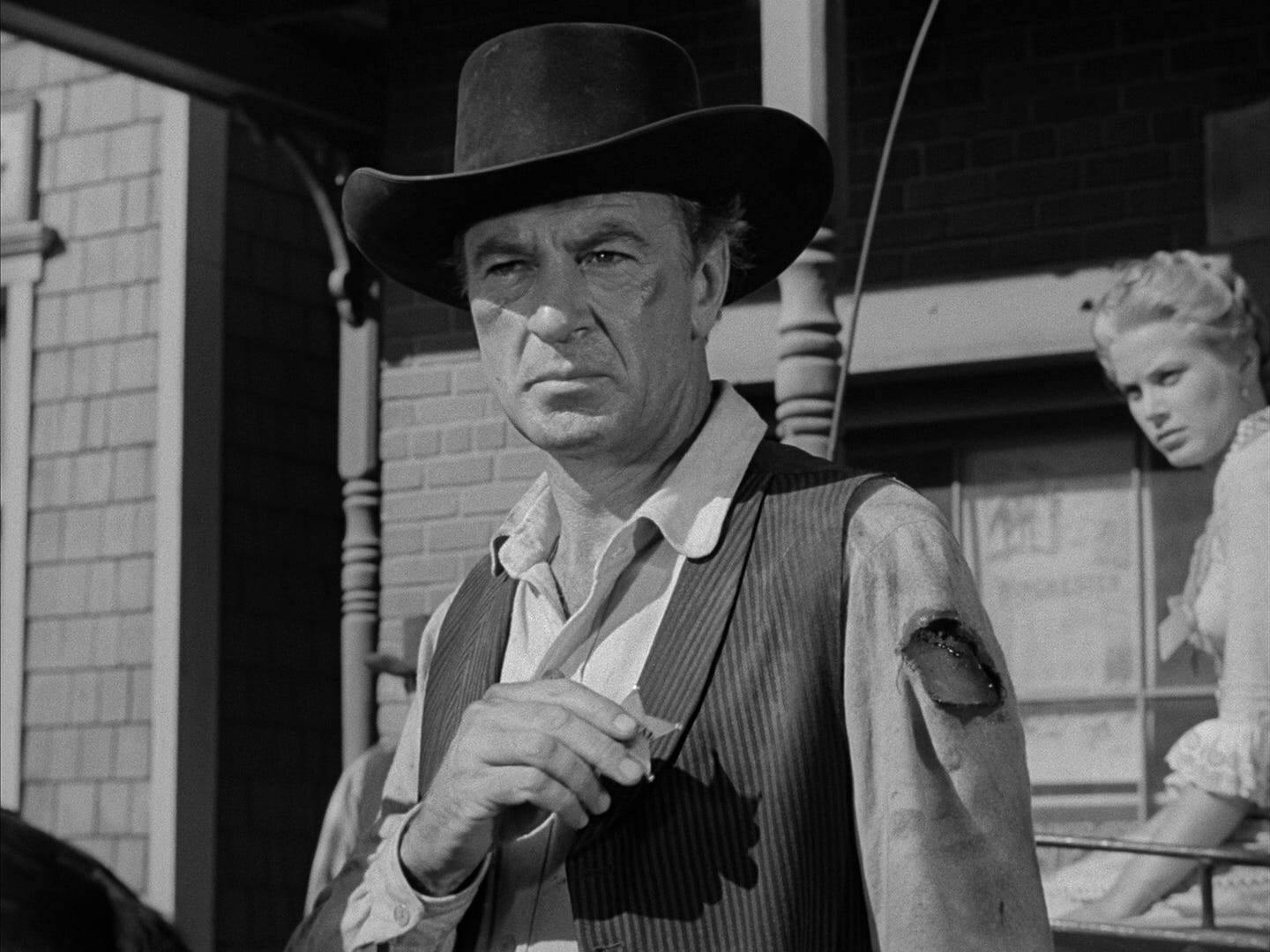
A marshal stands in the street, staring at the townspeople in disgust; among them are his colleagues, friends, and neighbors. He grabs his badge from his chest, holds it between his fingers for a fleeting moment, and, without breaking eye contact, flings the badge into the dirt. Without a word, he climbs aboard his buggy and rides away with his new bride. Why is the marshal’s journey edifying? Why is the bleak ending, while unsettling, not entirely devastating? Is this a story about one man’s courage, a town’s cowardice, the inescapability of violence, or something else entirely?
Produced by Stanley Kramer, directed by Fred Zinnemann, and featuring an incredible screenplay by Carl Foreman, High Noon (1952) is an all-time classic Western film. Today, it is also almost universally understood as a political allegory for the 1950s blacklist and the House Un-American Activities Committee (HUAC) pressure. Many argue that this allegorical reading is the reason for the film’s importance and its enduring popularity.
High Noon has become so thoroughly associated with political allegory that it's nearly impossible to separate the film from this reading. However, on its release, there was no commentary on its connection to HUAC, the blacklist, or the political subtext1. Furthermore, the production team and cast were apparently not thinking about this at the time, either. The behind-the-scenes featurette, “Oscars and Ulcers: The Production History of High Noon” from a recent home media release commented:
Back in Hollywood, it was business as usual. If anyone in the cast of High Noon noticed they seemed to be reenacting Foreman’s nightmare, abandonment, and persecution, none of them remarked on it.
So, it seems that the allegorical reading did not appear immediately but emerged in the years following the film’s release and picked up cultural steam during the early 1970s. Perhaps it was John Wayne’s Playboy Interview in May 1971 that brought this topic to a wider audience:
Everybody says High Noon is a great picture because Tiomkin wrote some great music for it and because Gary Cooper and Grace Kelly were in it…It's the most un-American thing I've ever seen in my whole life. The last thing in the picture is ole Coop putting the United States marshal's badge under his foot and stepping on it.
Wayne slightly misremembers the exact ending—Coop (Gary Cooper playing Will Kane) doesn’t step on the badge—but the symbolic gesture is on point.
Fred Zinnemann, in 1973, discusses2 “that Howard Hawks has said on various occasions that he made Rio Bravo as a kind of answer to High Noon,” while in a 1974 interview Howard Hawks outlines his main objection3 :
I made Rio Bravo because I didn’t like High Noon. Neither did Duke. I didn’t think a good town marshal was going to run around town like a chicken with his head cut off asking everyone to help. And who saves him? His Quaker wife. That isn’t my idea of a good Western.
Wayne’s objection is not rooted in the allegorical interpretation, and Hawks’ dislike for the film is rooted in the narrative and whether it’s a good Western or not. It is also interesting that Wayne and Hawks have different (but similar) objections, and that none of them explicitly involve the allegorical interpretation.
High Noon provoked objections from Hawks, dismissal from Wayne, and later became canonical blacklist allegory—three entirely different readings with almost nothing in common. What quality in the film permits such divergent interpretations? What is High Noon actually about? To answer that, we need to set aside the opinions, critical discourse, and conjecture, and watch the film itself.
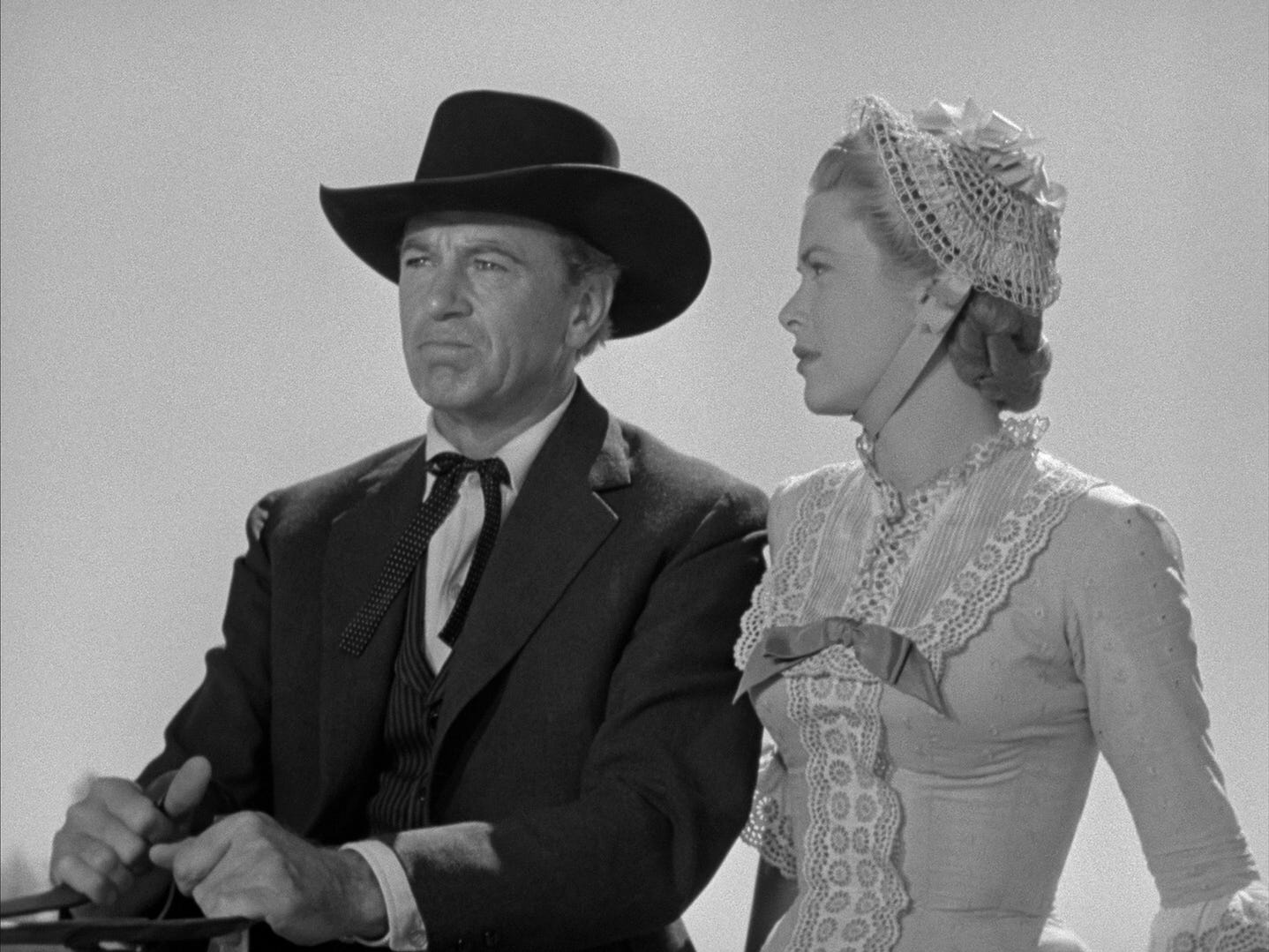
We first meet Will Kane at his wedding to Amy Fowler. It’s a typical ceremony in front of a justice of the peace. Immediately afterwards, in a quiet one-on-one moment, Kane says, “I'm going to try, Amy. I'll do my best,” to which Amy responds, “I will, too.” It's sincere, but it lacks the confidence you'd expect between newlyweds. In the moment, it’s not fully explained what this line means, but it suggests that Kane and Amy are not exactly on the same page, and there is some real chance that this marriage will require work, and perhaps even luck, to survive and flourish. The film initially suggests that the incompatibility is about lifestyle: Kane as lawman versus Kane as domestic store owner. However, this is a red herring. As we will soon find out, the real fracture is more serious—a fundamental disagreement about values that runs deeper than mere profession.
Upon hearing the news of recently released outlaw Frank Miller’s imminent arrival on the noon train, all of the wedding guests convince a hesitant Kane to keep to his original honeymoon plan of leaving town for his new life. However, traveling on the dusty road gives Kane some time to think, and he realizes that he can’t leave. Amy doesn’t understand, and Will, in a motif that Foreman uses throughout the screenplay, doesn’t have the time or inclination to explain it to her before they head back to town:
Amy:  I don’t understand any of this.
Will: Well, I haven’t got time to tell you.
Amy:  Then don’t go back, Will.
Will: I’ve got to. That’s the whole thing.
Kane and Amy’s potential incompatibility is now revealing itself further. She doesn’t understand why he has to go back, and Kane can’t explain it to her.
So far, High Noon is comfortable operating within the realm of the classic Western genre tropes. A peaceful town, a vicious gang arriving to unleash chaos and seek their revenge on the man who put them away. The marshal is the conventional Western hero: laconic and duty-bound; an archetypal strong and silent type who acts without explanation.
Once back in town, Kane and Amy have a confrontation where their relationship ultimately cracks. Kane is steadfast in his belief that he has to stay while Amy won’t back down from her Quaker belief in pacifism, which eventually culminates in Amy’s refusal to stand by her husband: “You're asking me to wait an hour to find out if I'm going to be a wife or a widow. I say it's too long to wait. I won't do it.” Amy pleads with him to leave with her and avoid this conflict, but Kane maintains his steadfast resolve: “I can't.”
This marks the first point in the film where Western tropes are subverted, and it is through Kane’s refusal to embrace the mantle of hero:
I'm not trying to be a hero. If you think I like this, you're crazy.
It is also the first hint of motivation for Kane and it goes against type and suggests the fundamental conflict the film will explore. Kane is not returning to be a hero or even to save the town—he’s returning because he must.
Kane embodies what I call a Mythic Constant—a character who represents an unchanging principle rather than undergoing transformation. In High Noon, this plays out through his clash with Amy over values, through the town’s abandonment, and through Kane’s temptation to flee.
Kane next encounters the justice of the peace, Percy, who is busy packing his things. Percy explains why he thinks the community will be of little help, planting the seeds in the viewer for the townspeople’s later refusals. Kane listens, doesn’t argue, and eventually watches Percy leave.
Following this is Kane’s interaction with Deputy Marshal Harvey Pell. Harvey is aggrieved that he wasn’t selected to succeed Kane as marshal and tries to use this emergency to his advantage by offering his support on the condition that Kane gets him the permanent marshal’s job. Kane flat out refuses, “Sure, I want you to stick. But I'm not buying it. It's got to be up to you.”
Kane then tries to raise a posse in the saloon, but with no luck. When Kane is asked about why Harvey quit, he responds, “That’s between the two of us.”
After failing at the saloon, Kane heads to Sam’s house. Sam, who was present at the wedding, hides in a backroom while his wife unconvincingly lies to Kane about Sam’s whereabouts. Importantly, Kane knows she’s lying.
The next stop for Kane is at the church. It starts out promising, with many men willing to help, but eventually, the townsfolk talk themselves out of volunteering for one reason or another. It’s a disappointing turn for both Kane and the audience.
The final stop is Kane’s idol, mentor, and friend, Martin. Martin also refuses and advises Kane to “get out.” In all of Kane’s interactions with the townsfolk, he’s been quiet and accepting of their decision but with his friend Martin, he asks for help again as directly as possible. He is still rebuffed and this rejection hits Kane hard.
Looking back at all of these scenes, we can see the themes emerge. Kane asks for help and is constantly rejected. At every turn he’s told that he should leave, that he should “get out.” But that’s exactly the one thing Kane can’t do. Kane can’t leave because it would violate his values and, in High Noon, Kane is a Mythic Constant Character representing the principle of integrity. Kane resists the hero’s role, but cannot abandon fidelity to his integrity. His specific values—honor, duty, community—matter less than the structure they create; Kane simply cannot betray who he is. This manifests itself through temptation that tests whether integrity can endure under constant, systemic pressure. Kane isn’t making a difficult choice—he is revealing that, for him, there is no choice at all.
Kane’s integrity is also tested in other ways besides the strict refusal help. One I mentioned above is Kane refusing to be blackmailed by Harvey in return for his assistance. Another is the small but noticeable gesture of keeping that interaction with Harvey private. And others, such as Kane refusing the help of a young boy and Kane refusing the help of Jimmy—a one-eyed, broken down man who perhaps drinks too much. To Kane, his integrity is his ultimate value, more important than his marriage and, even, his life.
Now that we know the underlying value that drives everything that Kane does, we can contemplate what makes the story tick. The obvious answer is time: the ever-present clock that imposes constant pressure within the story. It’s an important part of the structure that makes the film work but what really makes the story work, is not the near real-time narrative but a character. And it’s not Kane’s wife Amy or any of the other characters we’ve already encountered. Surprisingly, it’s a character we don’t meet until over halfway through the first act: Helen Ramirez.
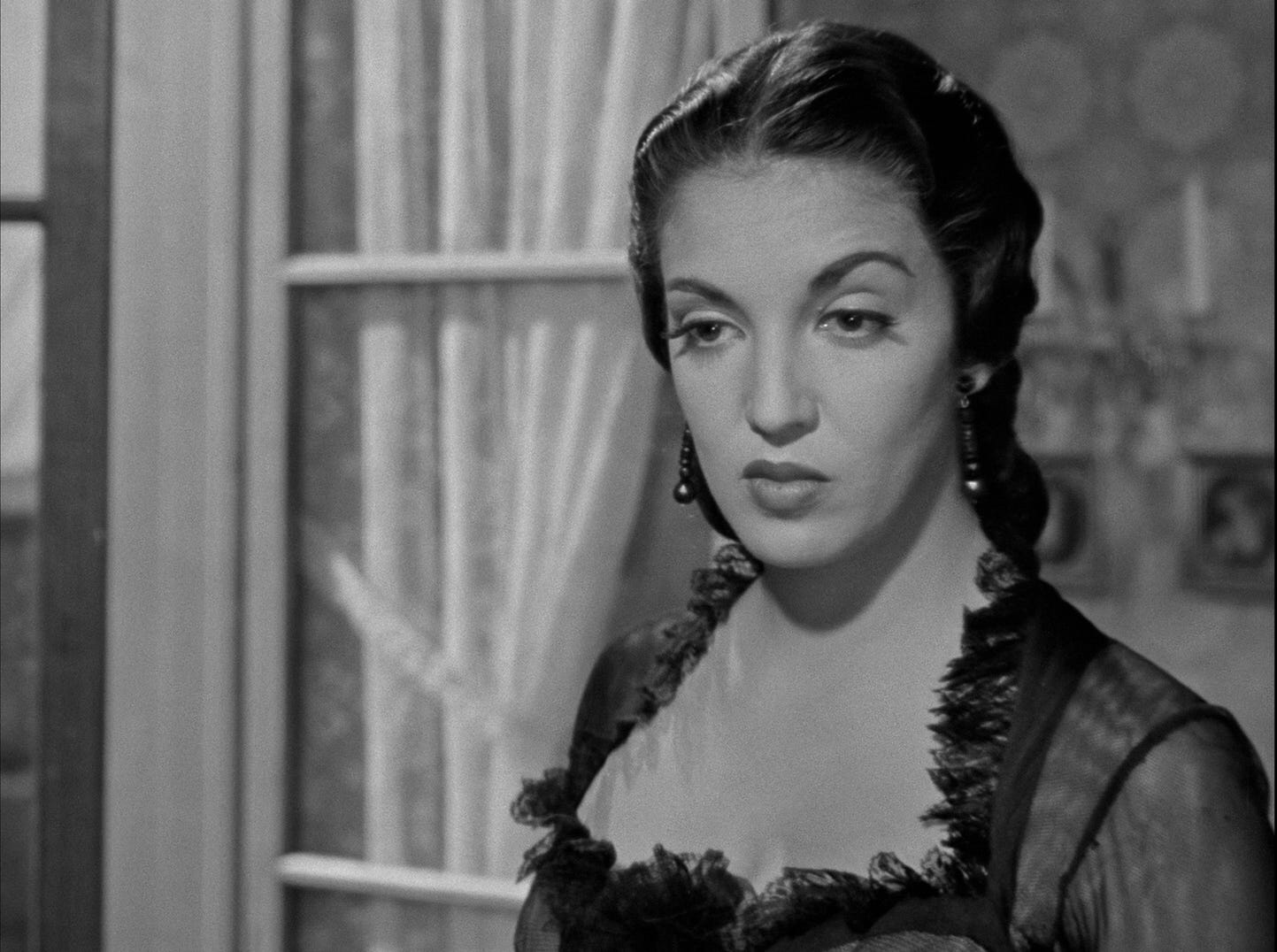
We’re first introduced to Helen Ramirez in a brief scene with Harvey Pell, her current beau. Later, in a follow-up scene, Helen and Harvey are still together, eating in her room:
Helen:  Harvey, don't you think Kane will be looking for you right now? You're really sore at him.
Harvey: Wouldn't you be if you were me?
Helen:  I suppose...if I were you.
This scene hints at Helen’s function within the story and why she is so important. She functions as a Greek chorus, articulating truths that clarify what others cannot see. Not only can she see and understand everyone’s motives, she names them for the viewer. Although, we’ll see the one exception later.
Helen’s chorus function is more readily apparent in another scene with Harvey, where she explains clearly how Harvey doesn’t measure up to Kane as a man (and probably never will) as well as setting the stakes for the upcoming showdown:
Kane will be dead in half an hour.
And nobody's going to do anything about it.
And when he dies, this town dies too.
In another important scene, Kane comes to warn Helen about Miller’s imminent arrival.
Helen: Kane...If you’re smart, you will get out, too.
Kane:  I can’t.
Helen: I know.
Here, Helen reveals the truth, confirming Kane’s nature; it’s not that Kane refuses to leave, it’s that he is unable because that would violate his core value of integrity—something he cannot do no matter the amount of pressure. And Helen’s resigned response of, “I know” shows how she understands the motivations of everyone involved in the story. With one exception.
The one blind spot Helen Ramirez has is with Kane’s bride, Amy. Structurally, this is perhaps the key moment of the film. It’s the moment when Helen becomes both chorus and a catalyst for transformation.
“What kind of woman are you?”
Helen’s next scene following her breakup with Harvey is with Amy. In that scene, she explains to Amy that Kane is not staying for her sake, and as Amy turns to leave, Helen can’t hold back any longer. She accusingly asks, “What kind of woman are you?” In this scene and Helen’s previous scene with Harvey, Helen acts as chorus and the scenes even have slight mirroring. In Harvey’s scene she explains what will happen to the town and in the scene with Amy, she explains that Kane isn’t staying for her—though, she can’t explain why he is staying either. Helen also questions both Harvey’s and Amy’s roles: Harvey’s manliness despite his broad shoulders and Amy’s loyalty as wife. But there is a difference: Helen understands Harvey perfectly and doesn’t really understand Amy at all. Helen only softens after Amy reveals her trauma: she witnessed her father and brother gunned down despite being in the right. From that incident, she became a Quaker, embracing nonviolence as protection. The scene concludes after this admission, and it appears to the audience that these scenes are true mirrors of each other but the screenplay has a trick up its sleeve. After cutting away to scenes of Harvey and Kane, a quick 30-second coda to Helen and Amy’s scene occurs. It’s become clear to Helen that Amy’s pacifism is a response to her previous trauma, and that she is acting not from a deep-seated character flaw but from a false principle. This is when Helen becomes the catalyst for Amy’s eventual transformation by showing Amy what it means to fully choose Kane:
Helen: If Kane was my man, I’d never leave him. I’d get a gun. I’d fight
Amy:   Why don’t you?
Helen: He’s not my man. He’s yours.
It’s also worth noting that Helen doesn't entirely abandon her chorus function when she becomes catalyst. She continues to articulate truth. But now that articulation is directed at Amy's transformation rather than purely at the audience's understanding.
As the impending showdown begins between Kane and Miller’s gang, Amy sits on the train awaiting her departure. But when she hears the sound of gunfire, she realizes she can no longer abandon Kane; she runs back to town and into Kane’s office. Amy sits at Kane’s desk with her head resting in her hands, on his Last Will and Testament. It’s here that Amy finally grasps what Helen didn’t fully explain: that her pacifism applied to Kane is a false principle—it doesn’t spare the righteous but can lead to their death. This realization enables Amy to overcome her absolute pacifist principle, allowing her to act in Kane’s defense.
By the end, Kane is alone—isolated by his constancy. For those willing to witness it, Kane functions as pure symbolic force: integrity embodied without compromise allows us to experience that value before intellectual judgment takes hold. In the moment, we don’t debate whether Kane should stay; we feel his constancy as an archetypal truth. That felt experience is part of what makes the journey edifying. Yes, the ending is bleak because Kane loses the entire community; the town that should have shared his values abandons him. But it’s not devastating because Kane wins the one person who matters most. Amy's transformation shows that integrity, though isolating, can create genuine connection with those willing to understand it. We witness Kane's constancy, and we see it transform someone else.
High Noon inspired objections from Hawks (on narrative grounds), dismissal from Wayne (on patriotic grounds), and adoption as political allegory, which eventually became critical orthodoxy. But if High Noon's power derived solely from its HUAC allegory, the film's relevance should fade as the historical moment recedes. Instead, it remains as urgent and resonant as ever. This suggests the film's real strength lies not in political commentary, but in mythic structure that transcends historical moment.
But a question still remains: What makes High Noon inspire such different readings?
Once again, we look to the film itself. Zinnemann directs High Noon with an almost documentary style, which, with the addition of the perpetually ticking clock, grounds the movie in a dusty, sweaty realism. This naturalistic sheen obscures the mythic qualities of the story that are operating underneath. It’s this gap between form and content—realism and myth—that leaves a vacuum that invites alternate interpretations.
Another factor is the film’s refusal to explicitly name its themes or answer the big questions. Foreman’s use of this motif can be found in a variety of scenes:
Kane: I don’t have time to tell you.
Helen: If you don’t know, I can’t explain it to you.
Kane: I can’t do it [leave].
Harvey: Why?
Kane: I don’t know.
This is very mythic but also invites allegorical interpretations.
In a very real sense, High Noon is a myth in naturalistic clothing: that’s why the film endures. But also why its meaning can be so elusive.
Every Cinemyth essay is free, unlocking the symbolic structures behind classic films.
Austin Fisher, “Revisiting the Blacklist Western: A Reception Study of High Noon,” Journal of Cinema and Media Studies 61, no. 5 (2022): 137–58, https://quod.lib.umich.edu/cgi/t/text/idx/j/jcms/18261332.0061.506/--revisiting-the-blacklist-western-a-reception-study-of-high?rgn=main&view=fulltex
Fred Zinnemann, Fred Zinnemann: Interviews, ed. Gabriel Miller (Jackson: University Press of Mississippi, 2005), 44.
Michael Munn, John Wayne: The Man Behind the Myth (New York: New American Library, 2003), 190.