
The Natural (1984) occupies a peculiar place: neither a big hit nor a total failure, remembered as a classic yet strangely overlooked, an emotional powerhouse that somehow leaves the viewer wanting. While few people consider the film outright bad, critics remain split on whether it’s genuinely good or merely competent. In the battle of 1980s baseball movies, The Natural has long ceded cultural territory to the more deeply entrenched Field of Dreams. Even the film’s fondest memories tend to circle back to Caleb Deschanel’s glowing cinematography or Randy Newman’s soaring score.
So how does the film end up so much less than the sum of its parts? It isn’t Barry Levinson’s direction, nor the production design, both of which are impeccable. And the story itself is one of the most mythically discussed in popular cinema—variously described as a parable, a fairy tale, or an Arthurian legend. But myth demands coherence. It must deliver the meaning it promises, or else even the brightest spectacle rings hollow.
And that is The Natural’s central issue: it reaches for myth but never commits to a coherent mythic structure.
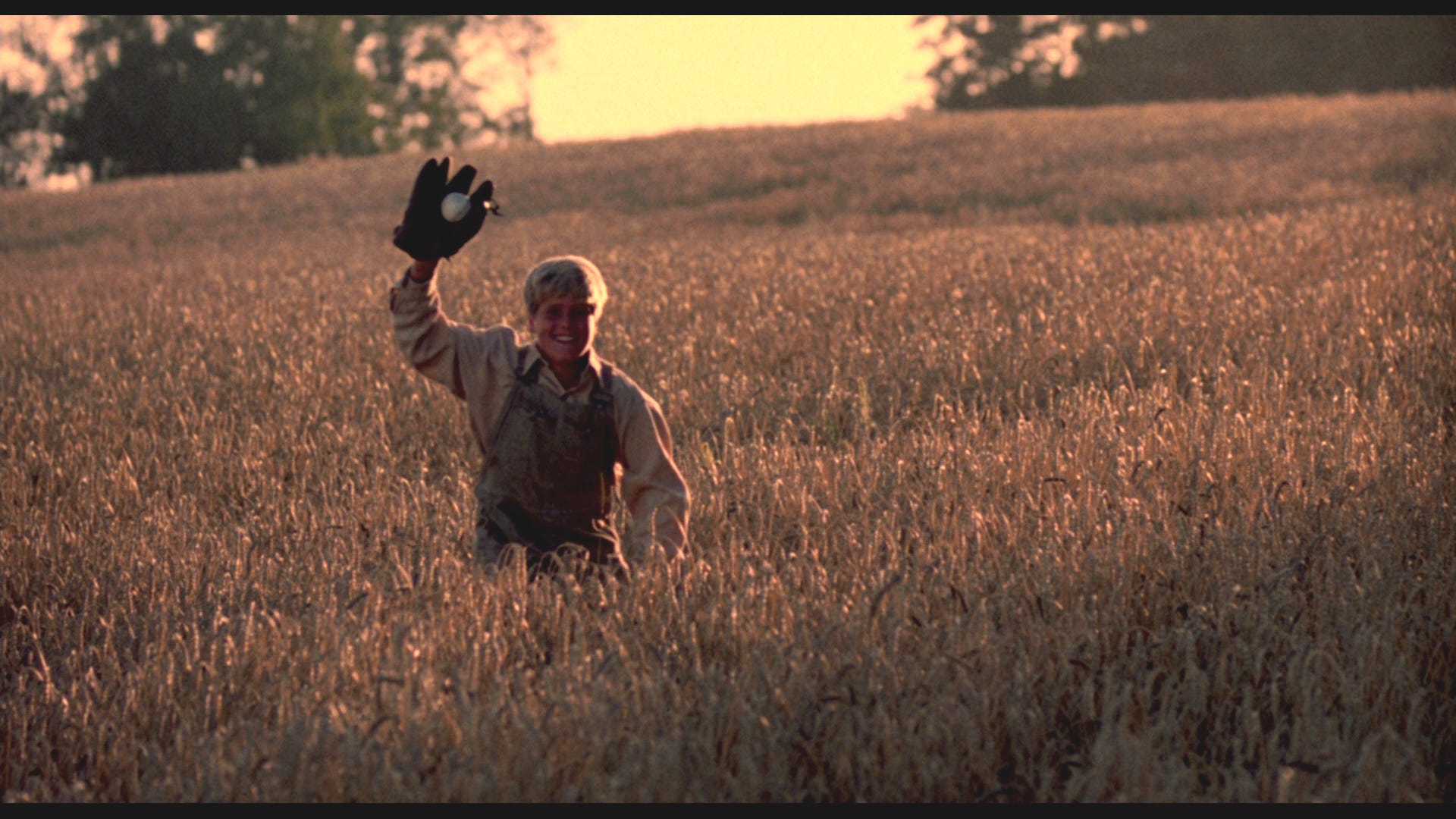
The film definitely puts its best foot forward with the potent duo of Deschanel and Newman. The opening is almost a montage, with Randy Newman’s Americana-infused melodies enhancing the images of nostalgic golden fields while Roy’s father imparts life lessons. The cinematography, the music, and the direction all lend these opening scenes a warm sense of nostalgia. It’s backstory, yes, but it feels infused with meaning even if it’s not apparent what that meaning is yet. But one thing is certain: the film leans into the feeling of halcyon days past: simpler times, better times.
Later Roy leaves the farm on his way to a tryout in Chicago. He strikes out The Whammer and attracts the attention of Harriet Bird, a literal woman in black, who talks with Roy alone in the dining car. She questions Roy about myths, asking about Homer and specifically about Arthurian myth:
It was just like watching Sir Lancelot jousting Sir Turquine. Or was it Maldamor?
Roy’s response of “I’m not sure” reveals him to be unfamiliar with Arthurian legend and the mythic knowledge the film suggests should matter. Roy expresses his desire to have people say, “There goes Roy Hobbs, the best there ever was,” to which Harriet responds, “Is that all?” It’s easy to miss, but when Harriet grabs Roy’s hand and the lights of the train flicker, it looks like Roy moves in for a kiss. But once the lights come up, the moment is lost, and nothing further comes of it. Was this Roy symbolically being drawn into the darkness by the woman in black? Roy asks Harriet if she’ll come watch him play, to which she responds, “Roy, you are priceless,” almost marveling at his innocence. In this scene, Roy doesn’t understand the myths that Harriet mentions, and all of the subtext of their conversation is completely lost on him. He does seem slightly tempted by her, but later, in Chicago, Roy goes alone to Harriet’s room and is equally bemused. He enters her room full of questions: “How’d you know I was staying here? What’s going on here?” before eventually being shot. It seems odd in the early 20th century for a man to go up to a single woman’s hotel room without knowing how that might look or what the reason for the invitation might be. From this we gather that Roy is a simple man who is naive in the ways of the world.
After the shooting, we fade in from black sixteen years later at Knights Field in New York City. Pop Fisher is lamenting his partner, referred to only as the Judge. He’s described as a “snake,” and whose arrival he calls “one of the darkest days of my life.” Roy Hobbs emerges out of a dark tunnel carrying nothing but a contract and a case containing his bat, Wonderboy. Soon we learn the stakes: if the Knights win the pennant, Pop Fisher can buy out the Judge. But if they fail, the Judge seizes Pop’s shares and takes full control of the team.
Narratively, this brings us into the middle of the second act, where the myth the film has been quietly constructing finally comes into focus. The fatherless Roy Hobbs leaves home as a young man to chase a dream of baseball glory. On the way he meets a myth-quoting lady in black who challenges his ambitions, tempts him, and ultimately shoots him. This test and fall ends Hobbs’ dream. Sixteen years later he returns with his hand-carved bat sealed in a case to join a team literally called the Knights, managed by a man named Pop Fisher, and eventually aided by a wise feminine character.
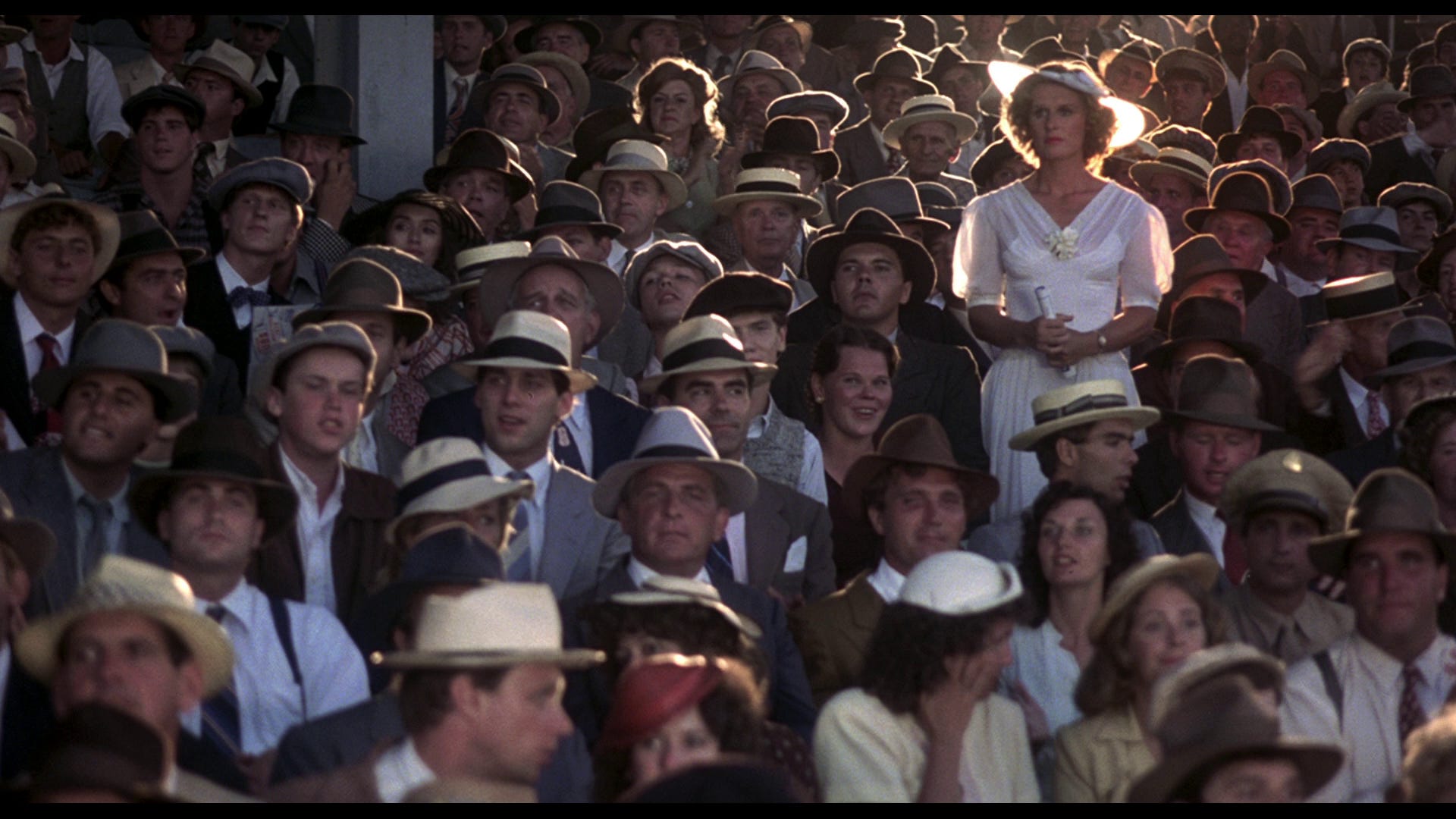
The Arthurian parallels are unmistakable: the direct Lancelot reference, the quest for glory, the sexual temptation, the failed test, Wonderboy as an Excalibur proxy (even housed in a scabbard-like case), Pop Fisher as a version of the Fisher King, and Iris as a healing woman.
In the opening scene, Roy’s father even names the core element of the quest:
You got a gift, Roy. But it’s not enough.
You gotta develop yourself.
Rely too much on your own gift and you’ll fail.
But this never happens: Roy Hobbs cannot complete the myth the film sets up, because the story never allows him to fall, struggle, choose, or change.
Roy’s internal development is almost nonexistent. The biggest problem is that Roy is written and portrayed by Robert Redford as not just simple and naive but almost unaware of what is really going on around him. He doesn’t understand the myths Harriet mentions, and when he fails his initial test, he is not sure what is happening or why. And even after his return, he doesn’t seem to have processed why he failed. In fact, he falls for Memo, who is a mirror of Harriet—even frequently wearing black. Hobbs acknowledges this later in the movie, recognizing the pattern when he tells her, “You were right, Memo. We have met before.” But he never grapples with what this actually means or what it says about him as a person. The film never shows him struggle with that realization or deal with the consequences.
Another oddity for the character who should be the protagonist is that he’s almost entirely reactive, rarely initiating any of the events of the film. Instead of being the knight on a quest, he feels more like a pawn: in the Harriet Bird encounter, she chooses him; with the Knights, he just sits on the bench, only getting a chance to play when another player is removed from the game; with Memo, he’s interested but doesn’t pursue her, and later he seems to stay with her simply due to inertia.
Maybe this passivity is the result of the film being terrified of showing Roy’s moral failure. Moments of sin are minimized or only suggested, framed as misunderstandings, or excused outright. One of the reasons why Roy never transforms is because he never truly falls. Some might argue that Roy’s fall is the shooting itself, but a mythic fall is never something that simply happens to the hero. A true fall emerges from flaw, choice, or blindness. Roy’s shooting reveals nothing about his interior life—it comes across as random and spiritually weightless. A hero cannot heal from a wound he doesn’t understand and never reflects on.
The script overall has quite a few nice touches and some good lines, with many earlier scenes mirrored later on that expand on the original ideas. For example, Gus the gambler echoes Roy’s father’s words, “You had a great gift, a talent. But it’s not enough.” If we could distill all of the issues in the film down to one scene or set of scenes, it would be when Roy falls ill and is recovering in the hospital. Roy isn’t being cared for in a regular hospital; it’s a maternity hospital, which, symbolically, is the perfect place for a rebirth. This is what the film is setting us up for. Hobbs has been stricken down and can’t play, Pops may lose the team; surely this is the moment where Roy confronts his past, heals his (literal and spiritual) wound, and is truly reborn. But instead, nothing happens.
Well, not quite nothing. During the scene in the hospital between Iris and Roy there are so many mythic doors that are opened during the conversation and never walked through that it’s actually quite astonishing. Roy starts by admitting that he’s still paying for his old mistakes, but he deflects about the girl on the train by saying he “didn’t even know her,” shutting down this line of questioning. Roy then admits that he liked her, but it seems like his main regret is that he “didn’t see it coming.” Roy now ignores contemplating the nature of his temptation or sin and focuses on not being able to avoid the consequences of his action. This time it’s Iris who lets him off the hook by excusing him: “How could you know she’d hurt you?” Finally Roy asks an important question about not seeing it coming: “Why didn’t I?” This is the question that should be the catalyst for introspection and, perhaps, even a transformation, but Iris again makes an excuse for Roy: “You were so young.” Next Roy laments that he could have broken every record, and Iris explicitly echoes Harriet’s earlier question, “And then?” which is the perfect opportunity for us to see what Hobbs has learned. But he literally repeats the exact same line he told Harriet earlier: “There goes Roy Hobbs, the best there ever was.” Iris then tries to guide Roy and takes the opportunity to explain the rebirth that could take place:
You know, I believe we have two lives.
...
The life we learn with and
the life we live with after that.
It’s a great line but one that has not been demonstrated in the film at all. And Roy’s response is classic Roy Hobbs: “How? What do you mean?” He just doesn’t get it. Finally it’s Iris who gives him a higher purpose: “Think of all those young boys you’ve influenced. There are so many of them.” But Roy just changes the subject, “That day in Chicago, why did you stand up?” derailing a potentially important understanding. And again, Roy starts to hit on a deep and important topic:
I wish Dad could’ve...
God, I love baseball.
But he cuts himself off, changing the subject. This is one of the key scenes in the film, and during this one conversation there were six chances to begin a transformative rebirth, but every time the film gets close to the door, it backs off.
And his pivot back to baseball right when he is on the verge of something deeper is very telling. It signals the film’s retreat from the Arthurian myth and its turn toward a second, competing myth that has been present all along, a myth that the film ultimately finds more comfortable.
This second myth is a longing for the uncomplicated moral backbone of early-20th-century America, with baseball serving as its mirror. In this myth, Roy Hobbs is less a person and more a symbol of purity, integrity, decency, and honor. The film’s oddities suddenly make sense when viewed through this lens. It explains why Roy doesn’t have a fall and why he leads a life without self-examination. It explains why Roy’s moral compass seems childish because childish innocence is the point. It explains the lack of tension around his “corruption” because he’s uncorruptible. Finally, it explains why Roy can’t grow, because if he grew, he would stop being the symbol the myth demands.
This is not a flaw in principle. It’s a perfectly valid approach to storytelling, and many iconic characters thrive in this role, with classic examples being James Bond or, more recently, John Wick. The issue in The Natural is that the film is telling two myths simultaneously and that these two myths are fundamentally incompatible. Each of these myths demands the complete opposite from the protagonist. The Arthurian legend demands that Roy fall, confront his wound, and transform into something worthy. The baseball-as-America myth demands that Roy not change so that the myth works. These contradictory demands are inversely opposed and contribute to the mythical incoherence; it’s a film laced with Arthurian symbols but deprived of true meaning. And when these two myths clash, the baseball-as-America myth always triumphs.
This disconnect originates in the adaptation from novel to film. The film inherited the Arthurian myth from Bernard Malamud’s novel but overlaid it with a baseball-as-American-virtue narrative designed for a happier ending, never reconciling the two. The irony is that Arthurian myth doesn’t demand bleakness—a redemptive, even triumphant ending is entirely compatible with the mythic structure, if the filmmakers had committed to it.
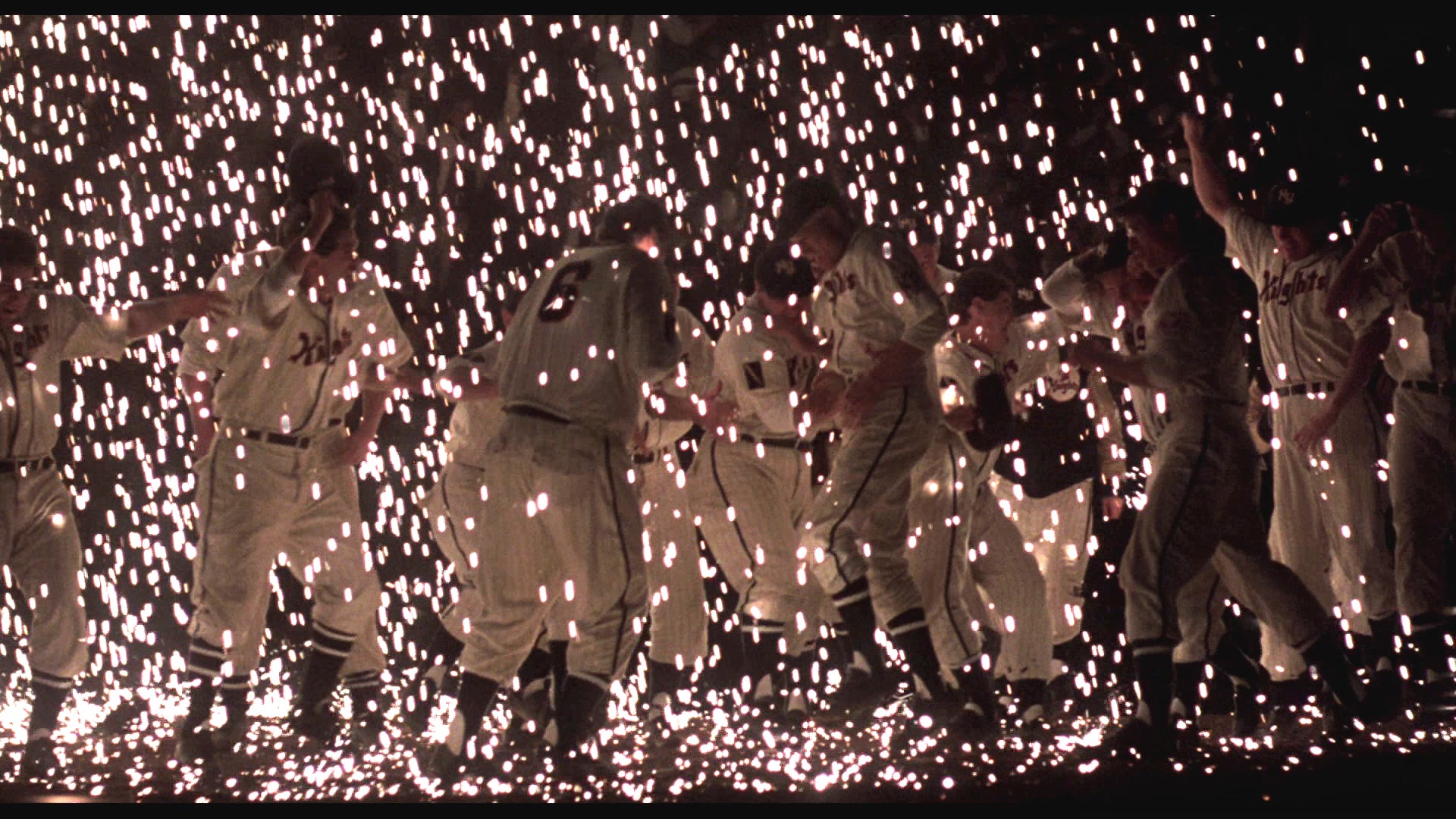
Nowhere is this disconnect more apparent than in the climactic scene. The imagery is magnificent, the music transcendent, and the emotional swell undeniable. But mythically, what is happening? Roy has been struggling all game because of his injury, and moments before his last at bat, he receives a note informing him that Iris’s son is also his son. And somehow this revelation grants him the power to win the game, save Pop Fisher’s legacy, and banish the Judge. But why? What changes? There’s no conversation, no internal conflict, and no resolution.
The moment is oddly muted. A policeman (a third party!) delivers a letter that Roy reads silently with a slight reaction. It’s perhaps the least mythic way to deliver the most mythic news. But these aren’t just execution failures; they’re consistent with the film’s refusal to show Roy’s internal reckoning. Any satisfying resolution would require Roy to take responsibility for his past and to make a choice and not just pace up and down the dugout looking around. But every path toward arriving at genuine meaning would force Roy to break the baseball-as-America archetype, and the film simply refuses to let him do it.
Rewatching the scene also reveals another problem: even if the performance had been flawless, there is simply not enough linear time for this revelation to mean anything. Learning that you have a son cannot be digested in a few seconds or even a few minutes. Bad news can crush a character instantly—it’s why the “I am your father” moment in Empire Strikes Back works. It takes time and struggle for meaning to form, for responsibility to take root, and for a person to change. The Natural tries to deliver a full mythic rebirth in the span of a breath, and the result borders on mythic parody: “I have a son? One-one-thousand, two-one-thousand… home run!” Destruction can be immediate; transformation cannot. Myth knows this. The film does not.
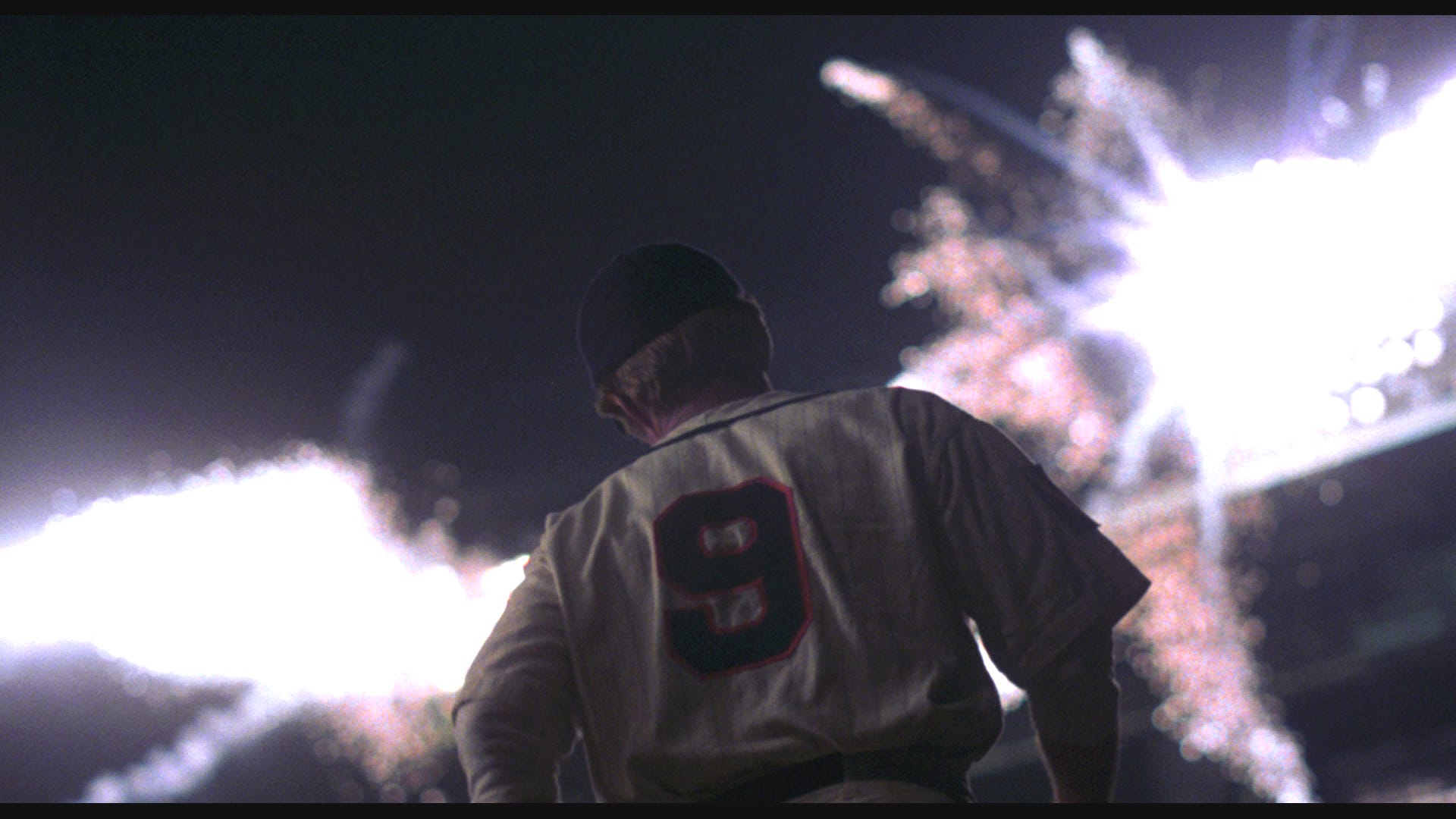
I’ve spent the last several paragraphs dissecting why the ending fails mythically. But the truth is that the scene itself is still great. It’s iconic for a reason. It’s one of the most perfectly crafted combinations of direction, cinematography, and music in 1980s cinema. And that perfectly encapsulates the split in how The Natural is viewed; it’s a film built out of extraordinarily mythic baseball scenes that are strung together with an emotional power the script never fully earns. Its images endure, even as the film proves that meaning can’t be conjured through aesthetics alone.
Ready for more insights? Every Cinemyth essay is free, unlocking the symbolic structures behind your favorite films. Subscribe now.