
Stargate’s First Act Miracle
Minimum Viable Myth vs. the Absurd Narrative
Let’s be honest: Stargate (1994) logically shouldn’t work. The narrative is full of holes, the ending lacks deep emotional payoff, and even the scene geography occasionally defies time and space. And yet, despite all these flaws the first act works through the power of sheer conviction. The film doesn't try to make narrative sense. Instead, it performs. It assembles symbols, characters, and music into a kind of ritual motion. Propulsion takes precedence over coherence. And there’s nothing wrong with that; Stargate isn’t a film to ponder the ethical dilemmas of interfering in another world, or to dissect military protocol for managing a portal to the stars. The first act has a simpler purpose: to bring you to the threshold and make you want to cross it.
Let’s dig in.
The Narrative of Shame
I may have actually understated the case above. Narratively, the first act barely holds together. Scene by scene, it’s a cascade of “cinema sins” stacked so high that, in the cold light of day, it becomes almost laughable. But that view misses the point entirely. Stargate isn’t trying and failing to make narrative sense. Like Tommy Lee Jones’ Marshall Gerard in The Fugitive, it just doesn’t care. As long as the myth is intact and the story keeps moving, logic can be left behind.
Borrowing a term from tech, I call this the Minimum Viable Myth (MVM).
The Minimum Viable Myth (MVM) provides the essential, bare-bones mythic energy that propels a story forward. It's less concerned with logical coherence than with raw narrative momentum. Let's see how Stargate masterfully employs this.
Minimum Viable Myth in Action
For these next sections, I’ll be referencing the theatrical version of Stargate, which omits an opening spaceship scene and a subplot involving fossils. If you're curious, Reddit has plenty of comparisons. But for our purposes, the theatrical version is the purest form of the MVM in action.
Let’s dive into a few key scenes from Act I to show how they succeed despite (or because of) their disregard for realism. This is where narrative nonsense becomes mythic propulsion.
Giza, Egypt 1928
Why it doesn’t make sense
In a scene that visually echoes The Ten Commandments’ “Obelisk Raising,” workers hoist the stargate ring upright with ropes — a move that would recklessly risk damaging a priceless, one-of-a-kind artifact. Meanwhile, a young Catherine Langford casually pockets a gold pendant from a dig table, with no adult or archaeologist so much as flinching.
Why it makes perfect sense
Raising the gate is an act of revelation allowing us to behold it as a mirror or doorway. As for the pendant, Catherine’s act links her to the gate and marks her as the steward of the mystery.
Why it really works
The scene is sprawling, layered, and filled with hundreds of extras, giving an immediate sense of scope and drawing us in. The light is golden, and the tone is reverent. A 37-second Steadicam one-shot follows the characters through the bustling excavation, immersing us directly into the lived-in world of 1928 Giza. It feels real, tactile, and grounded.
The next major shot follows Catherine up a ramp, cresting a ridge. The camera cranes with her, rising to reveal the stargate in full. David Arnold’s score fills us with awe and wonder at the mysterious object. It’s a classic reveal that channels Spielberg or Leone. These two reverent, prestige shots add cinematic weight and signal that this matters.
Little did we know that the rest of Act I would gleefully squander that earned trust by tossing narrative logic out the window in service of the Minimum Viable Myth.
Present Day Lecture
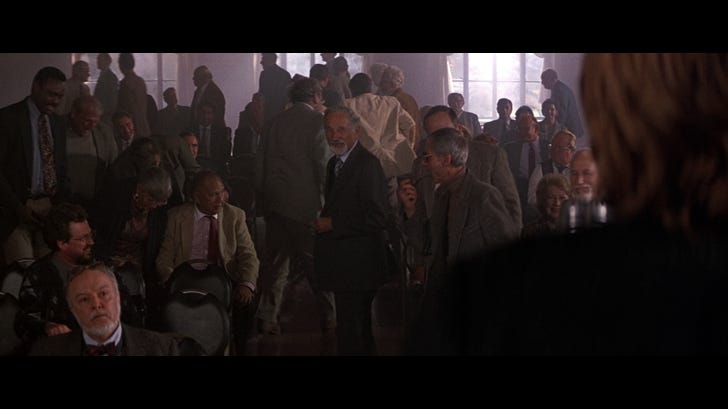
Why it doesn’t make sense
If Jackson is a disgraced academic, then why is his lecture fully attended by about 100 serious academics (at least judging by the sweaters, tweed, and glasses on display) who collectively decide to walk out en-masse?
Why it makes perfect sense
This lecture is actually a trial by fire and a public humiliation. Jackson must be ritually shamed, rejected, and cast out so that he can be reborn from a mythic journey.
Strange Job Interview in a Car
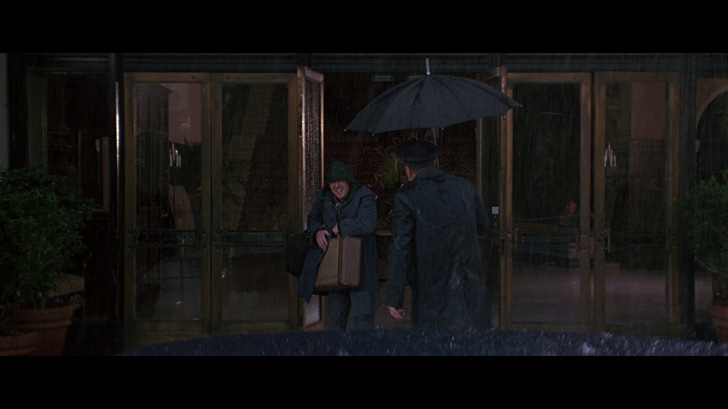
Why it doesn’t make sense
The improbabilities mount:
How does the weather go from bright sunshine to a torrential downpour in the time it takes Jackson to gather his things and leave the hotel?
Why does Catherine return to the car to wait for Jackson when she was just in the same (empty) room with him?
Why does she ask Jackson if the photo she is holding is of his parents?
Was Jackson really evicted that day? Does he really only own two bags worth of stuff? And how does Catherine know those two bags are everything he owns?
Why it makes perfect sense
The hard cut to the rain is almost comical — think Young Frankenstein (“It could be worse. It could be raining”). But the storm mirrors Jackson’s emotional state even if it breaks meteorological logic.
Catherine waiting in the car feels like a theatrical ritual and frames the meeting as mysterious and secretive. The invitation into the car and her inner circle offers Jackson a mythic lifeline.
The family photo reveal establishes Jackson’s archetype: the orphan who is disconnected from family and belonging. Humiliated, shunned, homeless, and without deep ties, he's the perfect character to heed the call.
Why it really works
It nails the Hero’s Journey beat. Daniel is summoned and momentarily refuses the call. And then, faster than you can say “Joseph Campbell,” he accepts. It may be the quickest rejection-acceptance combo in cinematic history — but with MVM, box-checking is often “good enough.” The propulsion matters more than the time spent. And in a clever twist, the film delays showing his acceptance until he’s already en route to Colorado.
The Wounded Warrior
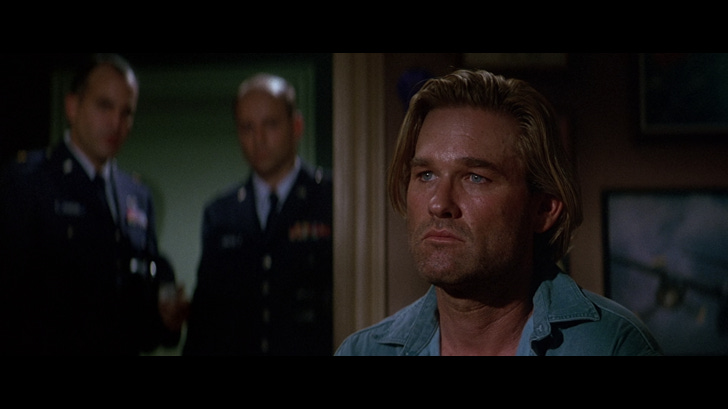
Why it doesn’t make sense
Why does General West’s office need to send two officers to Colonel O’Neil’s house just to say, “You’ve been reactivated”? Maybe a phone call or courier wouldn’t be sufficient for military protocol — but if it’s so serious, why only a single line of dialogue? And why two men? One to speak, and the other to hold the official-looking folder?
Why it makes perfect sense
This scene introduces O’Neil as the Wounded Warrior — a broken or tragic hero called back into duty. And two officers are required to deliver the exposition that re-frames everything we’ve seen: "His kid died — accidentally shot himself."
Why it really works
This scene is a masterclass in economical information density, delivering a full character backstory, emotional tone, and mythic setup in under two minutes and barely 60 words.
Beginning the scene, the car drives straight at the camera, adding a sense of kinetic momentum.
It’s autumn and the streets are covered with leaves; the seasonal death mirroring O’Neil’s grief.
The cut to inside the O’Neil home is a long shot down the hallway, reinforcing the family’s emotional isolation.
O’Neil’s wife lights a cigarette and delivers a single line: “You can try.” In just three words and one gesture, we see how far gone she is.
The child’s room, frozen in time, sets up the eventual reveal: O’Neil is a grief-stricken, potentially suicidal father.
O’Neil’s long hair subtly signals how long he's been suffering and withdrawn.
O’Neil remains completely silent throughout the scene, his distant, haunted eyes conveying the depth of his suffering.
And the final line the officers’ comment as they leave? It quietly reframes everything we’ve just seen.
The scene wastes no time on transitional movement; characters are simply cut to their necessary positions (e.g., inside O'Neil's house, outside the bedroom, then back in the car), ensuring pure narrative propulsion.
It’s a quiet scene, almost throwaway on first watch, but it's so perfectly constructed that any addition or subtraction would make the scene worse. And the emotional seeds it plants blossom later in O’Neil’s eventual redemption.
Cracking the Code
Why it doesn’t make sense
Deciphering the symbols, Jackson's breakthrough somehow merits an emergency meeting of top military brass, including General West, who is in full curmudgeon mode. The setting? A boardroom straight out of sci-fi central casting, with blinking lights and analog controls better suited to a Cold War launch center than a classified 1994 military facility.
And instead of telling Catherine (the person who recruited him) or even briefing the team, Jackson keeps it all to himself until the full high-ranking cast has assembled. Only then does he unveil his breakthrough in real time like the dorkiest TED Talk ever.
Why it makes perfect sense
This is ritual revelation and one of the highlights of Act I. The scene is structured around emotional rhythm and cinematic ceremony. Plot logic is a distant afterthought.
Why it really works
Jackson has completed a 12-minute mini-arc: from disgraced academic to Priest-Scholar, performing a revelation of truth. “He did it,” Catherine whispers with awe.
That mini-arc satisfies, but what elevates the scene is how it draws the audience into the ritual. We aren’t passive observers but now feel like active participants.
We learn the truth at the same moment the characters do. We are in the boardroom, too. That shared moment of discovery turns exposition into participatory revelation.
Seen in a theater, that effect multiplies. Dozens or hundreds of people share the same emotional beat, the same unfolding of understanding. That’s cinema as ritual. That’s why it works.
Threshold Crossing
Why it doesn’t make sense
In a baffling bit of mission planning, Daniel, the only person who can get the team home, is the last to go through the stargate.
Why it makes perfect sense
Plot logic is sacrificed (again) for maximum drama and tension. Daniel is the audience’s surrogate, so delaying his jump lets us focus on him to experience the wonder and terror of the stargate.
Why it really works
This is the literal threshold crossing of the Hero’s Journey. The hero steps into the unknown alone, and we're right there beside him.
Twelve minutes, four scenes, ten plot holes. Yet Stargate pulls us into its world from the very start, riding the giddy wave of Minimum Viable Myth.
Minimum Viable Myth Revisited
We've now seen how Stargate leverages the Minimum Viable Myth to create propulsion and intrigue in its first act. Now, let's take a closer look at the MVM itself.
The Minimum Viable Myth is the smallest functional amount of mythic coherence required to propel the story forward and maintain the ritual experience. Plot holes? Character contradictions? All acceptable collateral damage, provided the mythic current remains unbroken. Feeling is the true currency of its success.
And let’s be clear: I’m not using MVM as a pejorative. In a two-hour film, you have limited time to introduce a world, raise the stakes, and land the emotional beats. Practically and pragmatically, MVM makes that possible. But there’s more to it than mechanics.
There’s something inherently thrilling about the MVM. When a film commits to this approach, it sheds everything that doesn’t drive forward motion. What’s left is a distilled cinematic velocity: pure propulsion wrapped in mythic energy.
Why is this thrilling? Because it taps into our most primal narrative instincts. MVM bypasses logic and speaks directly to the emotional brain. It creates the sensation that something larger is unfolding, and that we’re being carried along with it.
Fueled by music, iconography, and visual rhythm, the film invites you to participate in a ritual.
But this is also the wager of the MVM: if the myth doesn’t land, if the ritual doesn’t resonate, then everything collapses. You’ve sacrificed coherence and plausibility, and if the mythic core fails to take hold, all you’re left with is noise. Sound and fury signifying nothing. Think late-franchise bloat (names withheld to protect the guilty), where hollow symbols and loud music try to paper over the lack of meaning. Without myth, the MVM is not actually viable.
Scratching the Surface
This deep dive into six major scenes barely scratches the surface of the wild, illogical brilliance that defines Stargate’s first act. From cars breezing past military gates without a check-in, to an omnipresent fog machine blanketing every corridor, to rifle-wielding soldiers casually wheeling cases and luggage around like it’s an airport baggage claim, the absurdities never end.
But in the world of the Minimum Viable Myth, they all serve a purpose.
Every oddity either ramps up mood, tension, or pace, or fulfills an even deeper function, like the examples above. This isn’t about realism. It’s about riding the wave, surrendering to ritual, and watching meaning emerge from myth.
Ready for more insights? Every Cinemyth essay is free, unlocking the symbolic structures behind your favorite films. Subscribe now.