
Pretty Woman is a 1990s fairy tale where a streetwise prostitute with a heart of gold learns how to be a Lady and is swept off her feet by a wealthy businessman. It presents itself as Pygmalion crossed with a modern-day Cinderella story: she gets the makeover, the shopping spree, and, of course, the kiss at the end. It’s a classic tale, updated with designer fashion and a generous dose of wish fulfillment.
But what if the story above is just a beautiful lie?
An illusion. A smokescreen.
What if the glossy sheen of this classic rom-com is pure misdirection?
What if beneath the fantasy lies a rich symbolic myth far older than Rodeo Drive?
At every turn, the film masterfully distracts us from what it’s really doing, even naming Cinderella within the story. And yes, the parallels are there: Vivian suffers humiliation (shopkeepers instead of stepsisters), keeps her dignity, and wins her prince. And, in a case of mythic foreshadowing hiding in plain sight, she even sings along to Prince's song “Kiss”.
As the credits roll against black we hear a voice declare, “No matter what they say, it’s all about money.” The image fades in to an extreme close-up of a magician’s hands performing coin tricks. And really, we should know better than to trust a magician.
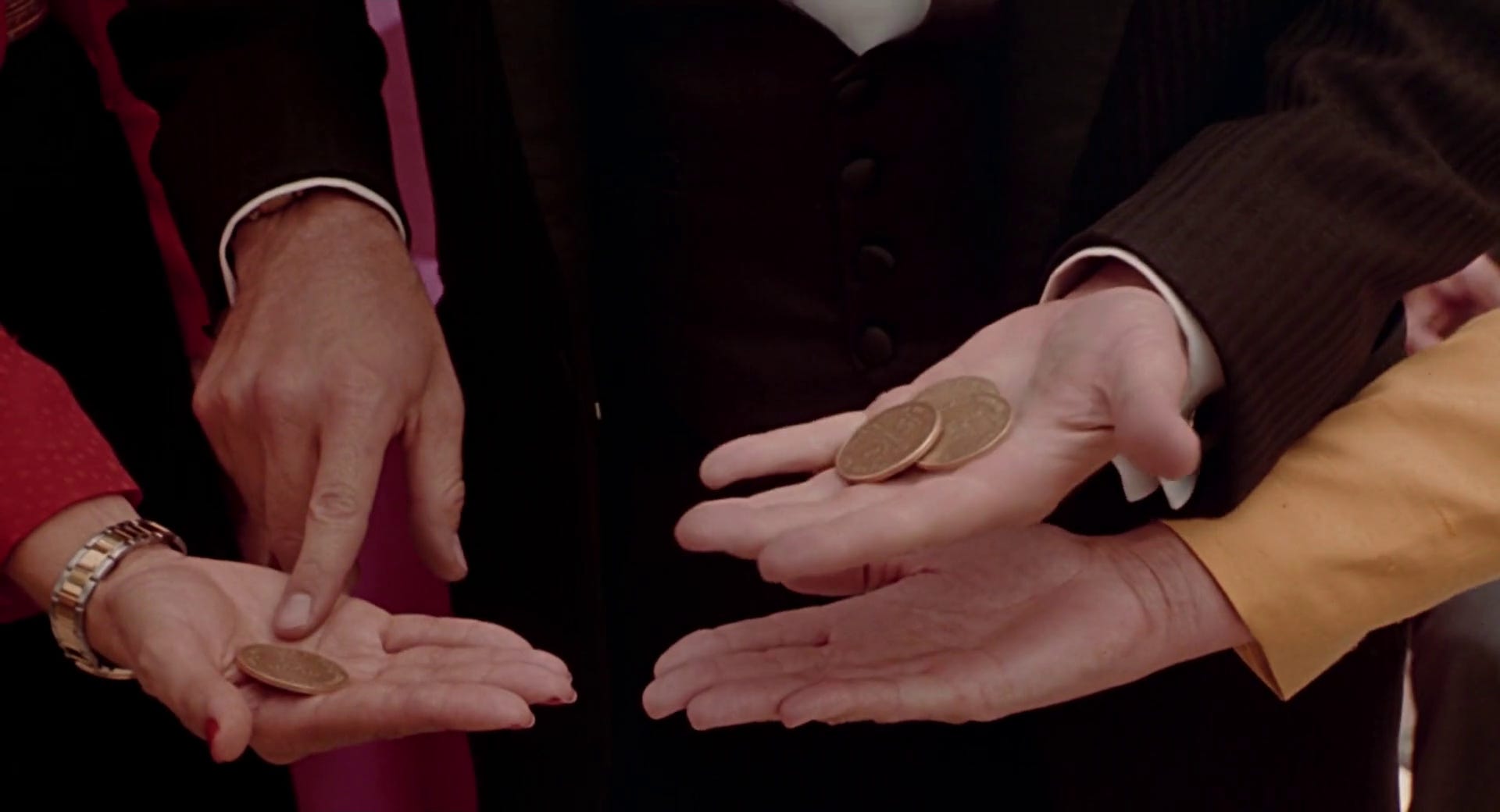
The film literally begins with a lie—a kind of audacious metaphysical irony. The magician’s patter echoes familiar, easy-to-accept clichés like “money makes the world go ’round”. Yet the story that follows will quietly prove the opposite: that some things are beyond money, that appearances deceive, and that not everything of value is transactional.
In its first twenty-five seconds, the film both announces its theme and reveals the meta-blueprint for how it will achieve it: through cinematic sleight of hand that hides the truth until its final reveal.
The camera pans, revealing a crowded party. We meet Philip Stuckey and hear talk of Edward Lewis, his client and friend. Stuckey doesn’t know where Edward is but assumes he’s “probably off in a corner somewhere charming a very pretty lady.” Not so much, actually; Edward is in another room arguing on the phone with his girlfriend, who resents being at his “beck and call.” They break up—efficiently. Moments later he bumps into a former girlfriend who reminds him that he was just as unavailable when they were dating, noting that his secretary was one of her bridesmaids. With calm authority, Edward instructs a colleague to check how the Morse stock opened on the Nikkei.
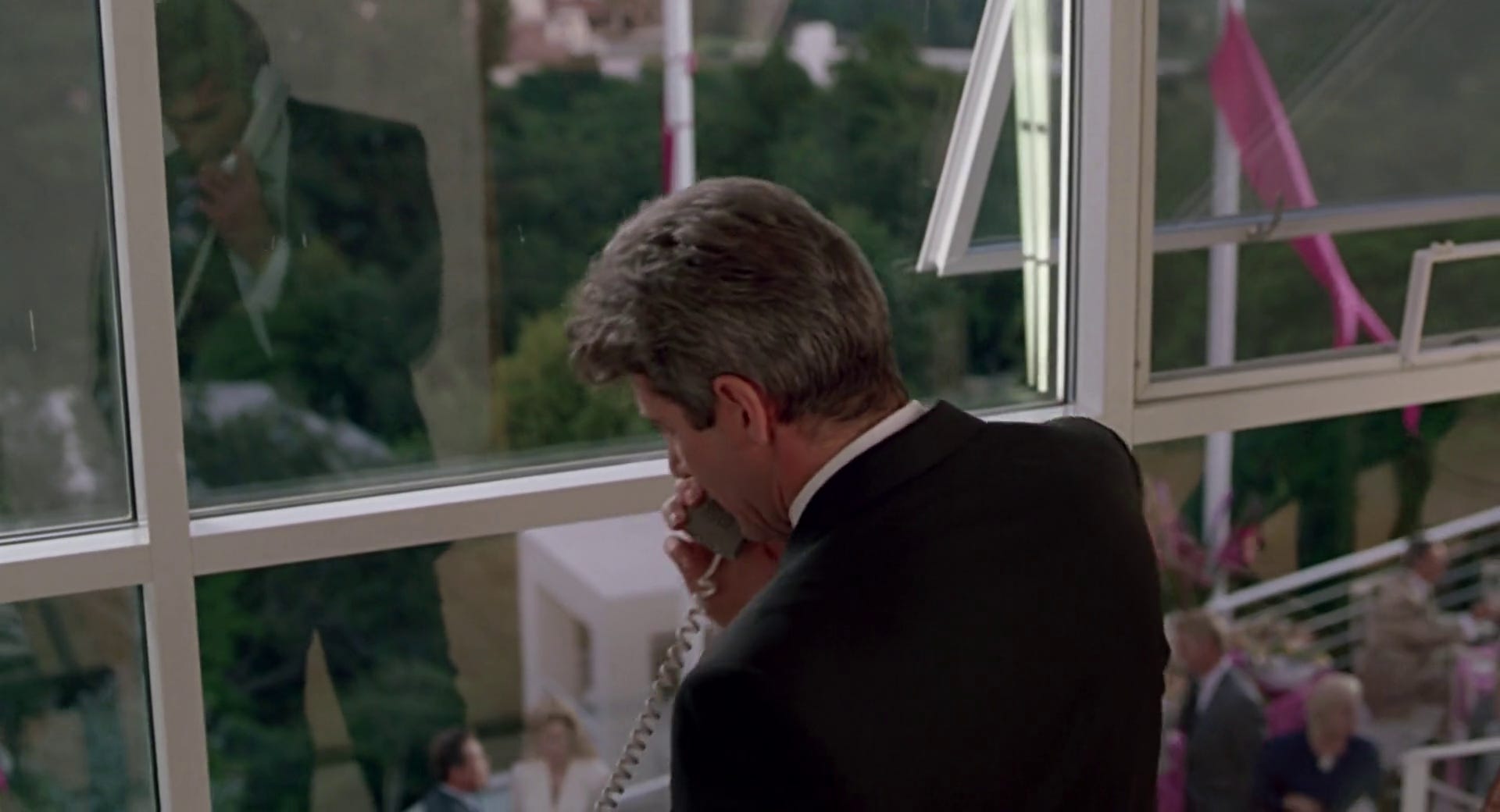
Night is falling. Edward borrows Stuckey’s car, a Lotus Esprit, intending to drive himself back to his hotel. This small decision sets the myth in motion.
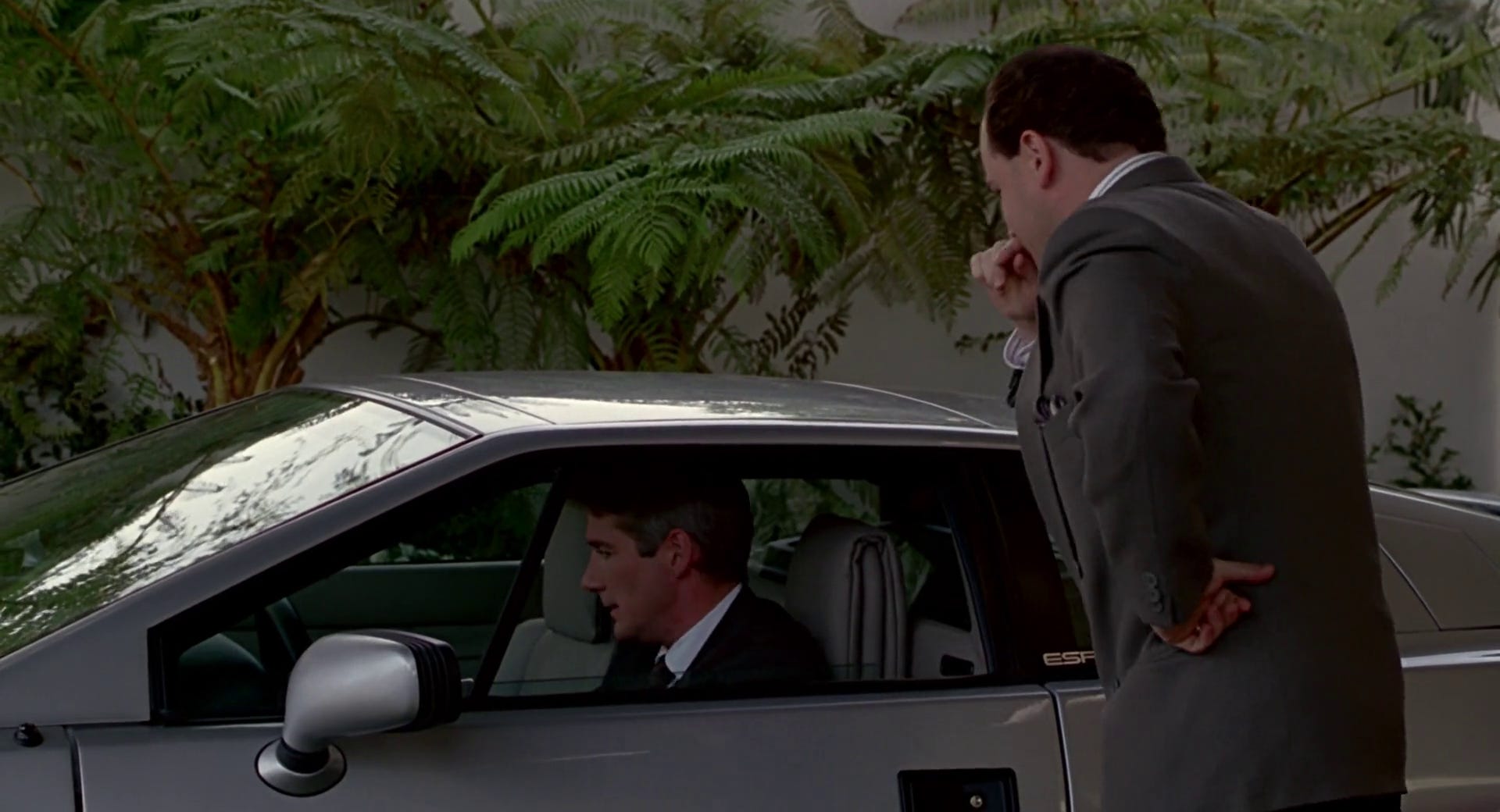
At the start, like many films, we’re dropped right into the middle of the action, with information coming fast. Here’s what we learn about Edward:
He’s popular, in demand, and a successful businessman who others are eager to be around.
Edward is still focused on work while attending a large party (even if it does involve business networking).
Edward seems direct and calm and treats people with respect even when in a position of power or engaging in conflict.
Edward has had many relationships. We meet two of them in quick succession, while Stuckey casually implies that Edward wouldn’t hesitate to charm another woman even while attached (though we never see evidence of infidelity).
He treated his breakup more like a business meeting than the end of a romance.
His in-person conversation with his ex-girlfriend is polite and friendly. Edward slightly hesitates when his penchant for communicating with his girlfriends through his secretary is confirmed but he seems to brush this aside quickly.
We hear mention of Carter and watch how effortlessly Edward evades the topic. Later we find out that Carter is Edward’s recently deceased father.
This is solid writing and gives us sharp character insights and plot points without relying on clunky exposition.
Edward heads out in Stuckey’s car but quickly takes a few wrong turns, eventually ending up on Hollywood Boulevard instead of in Beverly Hills. He finally pulls over, flustered and searching for the right gear (“First is here somewhere”).
Vivian and Kit spot the car pulling over and Vivian approaches. Edward, clearly lost, asks for directions. Vivian tells him directions cost five dollars; when he balks, she doubles the price to ten. Since Edward only has a twenty, Vivian offers to show him the way herself.
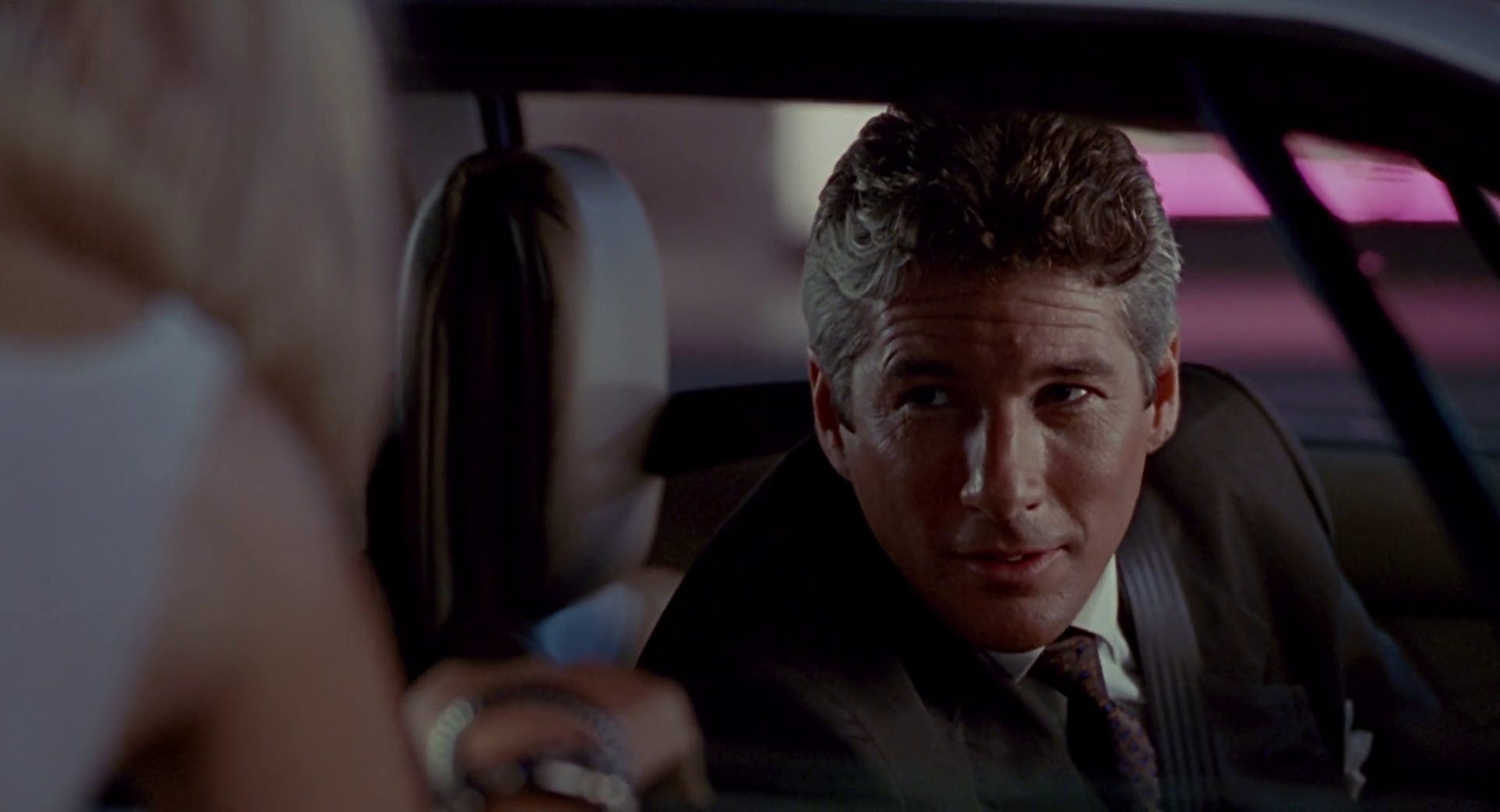
Edward keeps trying to drive, grinding gears and fumbling with the stick shift. Vivian, impressed by the car, remarks:
Man, this baby must corner like it’s on rails!
Doesn’t it blow your mind? This is only four cylinders.
Edward doesn’t quite understand. Vivian goes on to explain that he’s not shifting right because it’s a standard H-pattern, and he replies flatly, “Like I know what that means.” Finally, he gives up and tells her she’s going to drive.
Vivian takes the wheel and drives off, effortlessly and confidently guiding Edward through the city’s darkened streets toward the Regent Beverly Wilshire Hotel.
A quiet shift happens during Edward and Vivian’s interaction in the car. In a moment that adds little to the plot, Edward realizes Vivian understands the car better than he does and he cedes control, elevating Vivian from navigator to driver. Before this, we’ve only seen Edward in command: telling his associate to check the Nikkei, forcing Stuckey to loan him the car, even insisting on having the last word in a breakup after his girlfriend has already hung up.
It’s a small gesture, played with a light touch, and maybe it’s just efficient delegation, but symbolically it’s telling. The man who commands companies and conversations yields to someone he’s only just met; someone the world considers both profane and beneath him. The dynamic reverses and he surrenders the wheel of the Lotus to her. It’s a subtle foreshadowing of the mythic dynamic that fully develops later where Vivian guides Edward and drives the moral arc of the story.
And then there is the car itself: a Lotus Esprit. The Lotus flower has long been associated with enlightenment and rebirth, and Esprit in French means “spirit”, so the name Lotus Esprit quite literally suggests spiritual enlightenment.
Coincidence? In this case…probably. Ferrari and Porsche reportedly declined to feature their cars in a movie about a prostitute, but there were other options that might have been possible: Aston Martin, Lamborghini, Jaguar, and even American convertibles. Yet, somehow, the producers landed on a car where the symbolism is so on-the-nose that when pointed out it almost feels like parody: a car named spiritual enlightenment, driven by man who doesn’t know the way or even how to shift gears.
What’s next, a close-up of the princess in slippers?
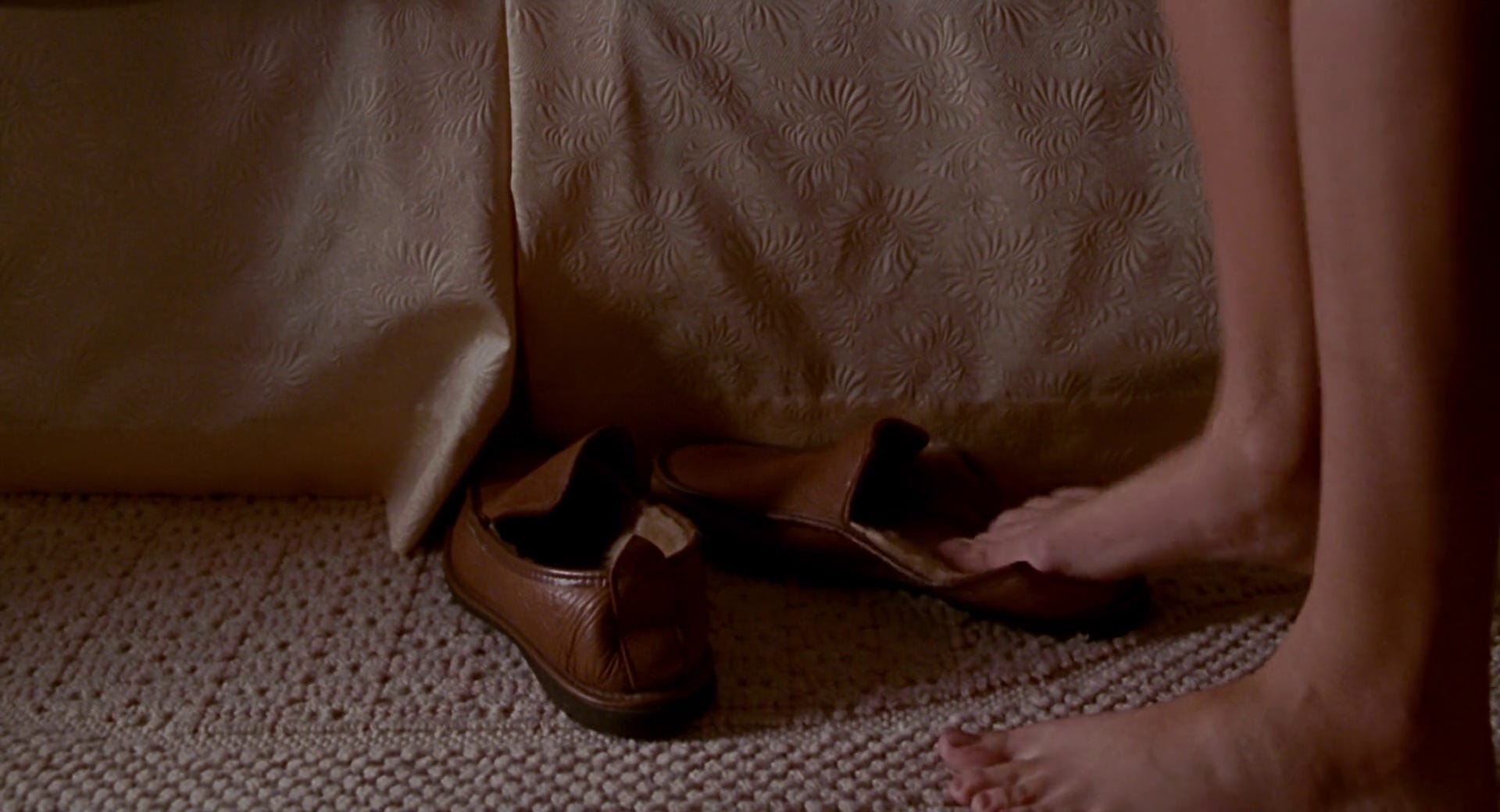
Oh, wait. They actually do that later on.
Both Stuckey and Edward have the wealth to purchase the trappings of enlightenment, but they lack the direction, skill, and insight to attain it.
Edward doesn’t even grasp Vivian’s description of how the car should drive. Later, he repeats it to Stuckey—“It corners like it’s on rails”—and Stuckey is equally baffled. It’s played for laughs, and it is funny, but the underlying truth is that neither Stuckey nor Edward (at least yet) understands the language of enlightenment.
During this examination of two of the opening scenes we’ve glimpsed some of their hidden meanings and symbols. It’s impossible to know whether these touches were intentional or simply “felt right” to the filmmakers, but hopefully it’s convinced you that Pretty Woman might be more than just a glossy rom-com. And if you’ve come this far, maybe you’re willing to come a little further to see what myth it leads us to.
But what myth does it lead us to? In this case, it’s a modern take on a centuries-old myth: the story of a wounded king, a lady from the water, and the healing of the wasteland.
Pretty Woman plays like a modern echo of an Arthurian Legend: Edward Lewis is the Wounded King, Vivian Ward is a Loathly Lady and Lady of the Lake, and hotel manager Barnard “Barney” Thompson, the priestly guardian of the inner sanctuary.
Writing this essay, I’m amazed by two things: how these thousand-year-old Arthurian legends, despite their age, still find ways to speak to us, and how director Garry Marshall pulled off the biggest trick of all by weaving those archetypes into a little 1990s romantic comedy without ever letting the seams show.
In Part 2 we take a deep dive beneath the surface to discover the Mythic Architecture of Pretty Woman, tracing the evidence through the film scene by scene.
Ready for more insights? Every Cinemyth essay is free, unlocking the symbolic structures behind your favorite films. Subscribe now.