
Once Upon a Time in the West: A Myth Carved Into Stone
How Leone turned Western tropes into mythic ritual
Once Upon a Time in the West is Sergio Leone’s masterpiece — a Western that draws on the genre’s most iconic forms, pares them down, and dilates them to a mythic tempo. An operatic story of judgment and reckoning, told through music, ritual, and landscape.
More than a film, it emerges as a slow-burning myth carved into stone.
Mythic Time
The myth in Once Upon a Time in the West unfolds not in narrative time, but in mythic time.
Mythic time isn’t measured in hours or days. It’s a time outside of time. It echoes geologic scale, but is infused with symbolic weight. It’s the tempo of ritual, of fate, of stories etched into collective memory. In Once Upon a Time in the West, these rituals manifest as repetitive, stylized actions and visual motifs that transcend mere plot points, acting instead as solemn guideposts to the underlying myth.
From the very beginning, Leone pulls us into that rhythm. The film opens with an eleven-minute sequence in which almost nothing “happens.” The dominant sounds are elemental and repetitive: the squeak of a windmill, the drip of water, the buzz of a fly. There is no music — only the ritual of waiting. It’s as if the myth cannot begin until time itself has slowed to the proper tempo.
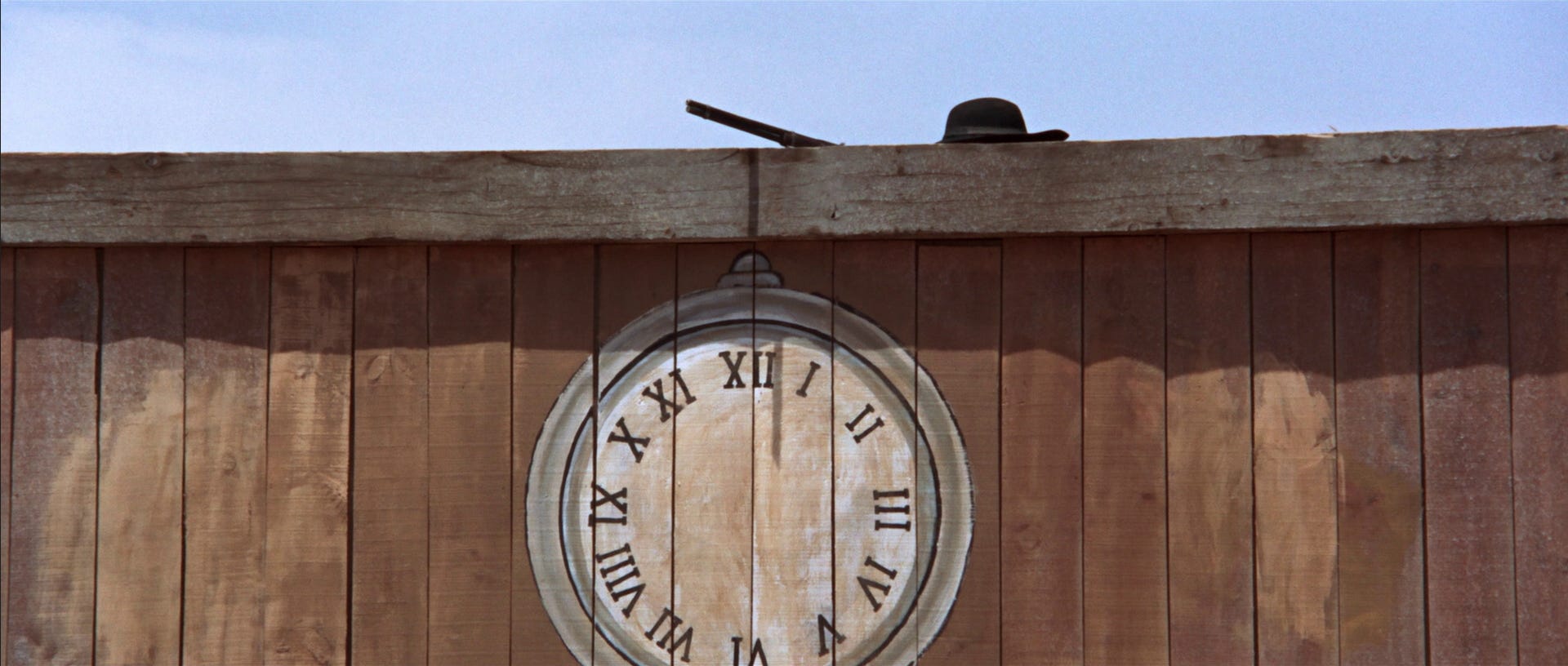
Throughout the film, Leone powerfully reinforces this feeling of time dilation through the repeated appearances of clock faces — especially empty or non-functional ones. Often displayed prominently in the frame, these images reflect not only the "Once Upon a Time…" aspect of the title but also the very tempo of mythic time.
Just as we need a geologic frame to perceive the movement of stone, in this story we need mythic time to truly see the myth unfold.
The Landscape as Mirror
The slow dilation of mythic time finds its perfect counterpart in a vast, enduring landscape. It’s no accident that Leone’s most mythic film draws upon the iconic geography of Monument Valley, a terrain already immortalized by John Ford as the cinematic embodiment of the American West.
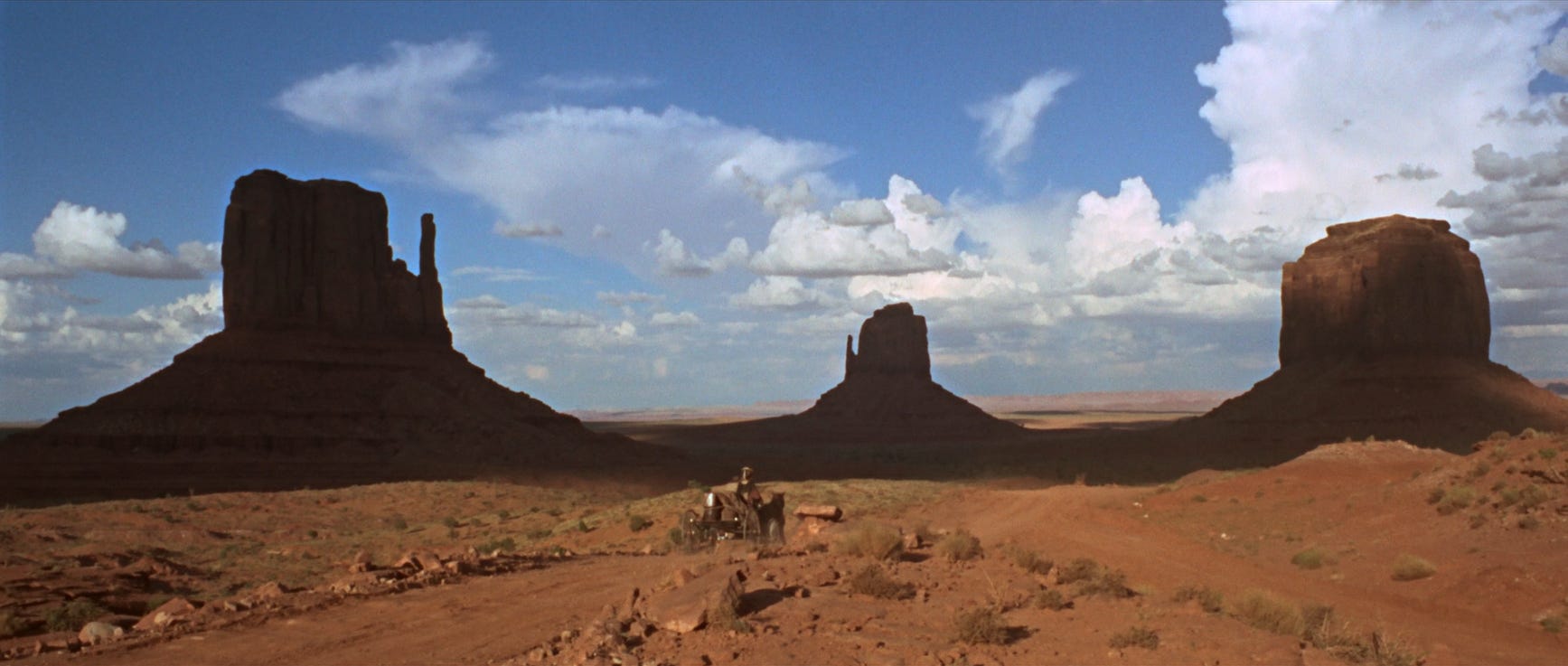
Ford’s Monument Valley films embody heroism, patriotism, loyalty, and resilience in the face of a harsh land. He uses the frontier to give scale and contrast while the landscape provides a backdrop against which human values shine.
Leone inverts this. He uses the land not as contrast, but as mirror.
Monument Valley’s towering buttes are unmoving, unblinking, unyielding. They are ancient, shaped by primeval forces, and, like the central figures of Harmonica and Frank, enduring.
Harmonica doesn’t change. He doesn’t grow, or evolve, or question himself. He isn’t a character in the usual sense — he’s a ghost, a whisper of vengeance given form, arriving not with urgency but with inevitability.
And Frank is also a constant. A titan outlaw who tried to outrun the old world only to be judged by something older still.
Both of Leone’s central figures arrive already forged. They don’t arc. They aren’t transformed. They collide. And through that clash the meaning of the myth emerges from who remains, and what values endure.
Sedimentary Meaning
In Leone’s mythic frame, meaning is sedimentary:
What begins as surface: a man, a gun, a train — reveals its layers slowly.
Each swelling Morricone phrase is another stratum: not merely score, but music elevated to mythic structure.
Leone’s visual language does the same: framing, entrances, even slight camera tilts carry symbolic weight.
Music and Harmonica’s Theme
Once Upon a Time in the West is scored operatically with each major character introduced with their own leitmotif, an identifying musical phrase that returns again and again. Beyond functioning as mere emotional cues, the leitmotifs' unwavering repetition serves to reinforce the immutable essence of these mythic constant characters.
Nowhere is this more striking than in Harmonica’s theme, which begins diegetically from the instrument he plays. Sparse and ghostly, it arrives before he does, and haunts the scene long before we understand who he is. This operatic technique, where the theme precedes the character, is also used for Cheyenne, but with lighter touch and less existential gravity.
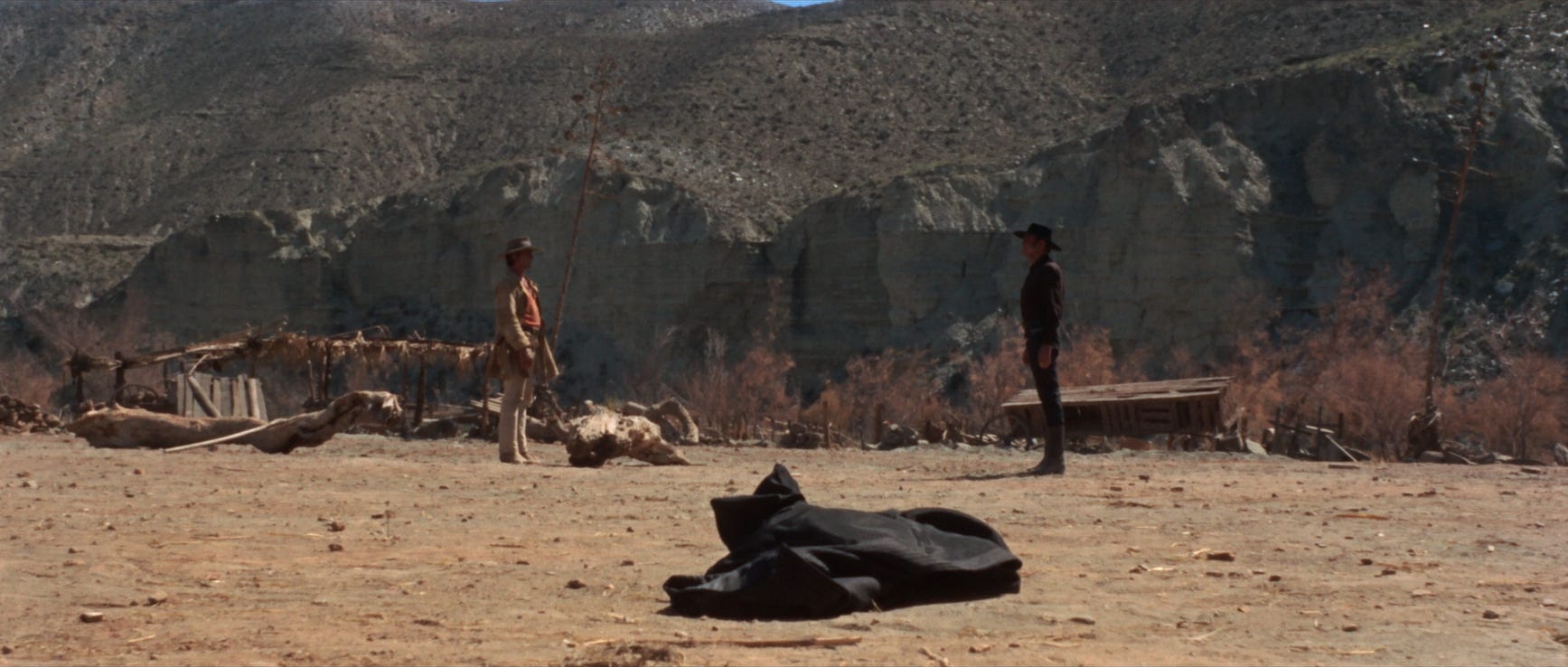
But there’s a deeper resonance: Frank and Harmonica are the only characters to share a musical theme. This musical intertwining directly reflects their mythically linked destinies. In the aftermath of the McBain massacre, when Frank is revealed we hear the wailing of the harmonica in the score even though Harmonica isn’t physically present.
The music is telling us what the story hasn’t yet: these two characters are bound by fate.
Visual Entrances as Ritual
Just as Morricone’s themes announce the presence of characters through sound, Leone crafts visual motifs that transform their entrances into recurring rituals. From Frank's first introduction to the way Harmonica enters the frame, these visual ceremonies consistently reveal the film's deeper mythic truths.
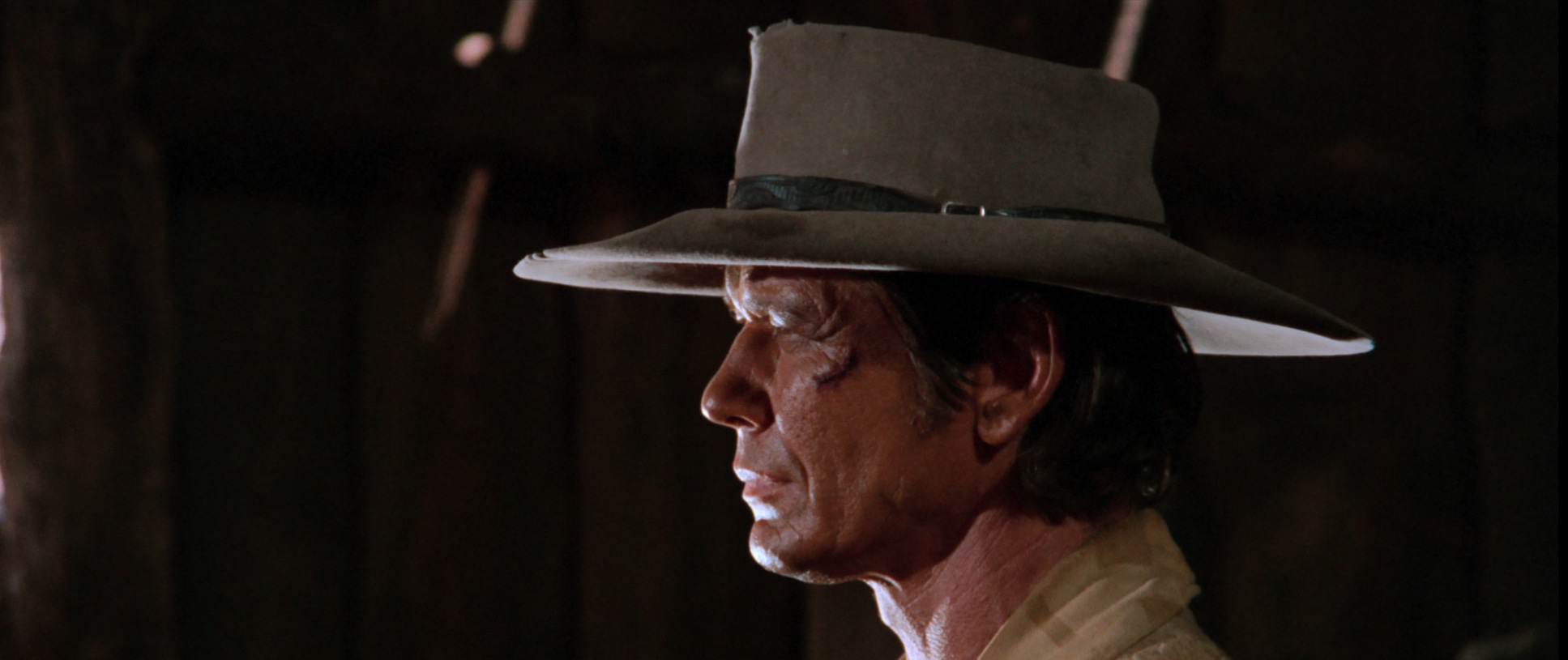
In virtually every scene, Harmonica’s appearance is revealed rather than shown:
Emerging from behind an object (a train, a post).
Moving from shadow into light (in the tavern, the McBain barn, Wobbles’).
Sliding silently into frame like a phantom.
These entrances form a recurring visual ritual. At first, you may not even notice. But the cumulative effect is unmistakable: Harmonica begins to feel less like a man, and more like a mythic force sent to pronounce judgment.
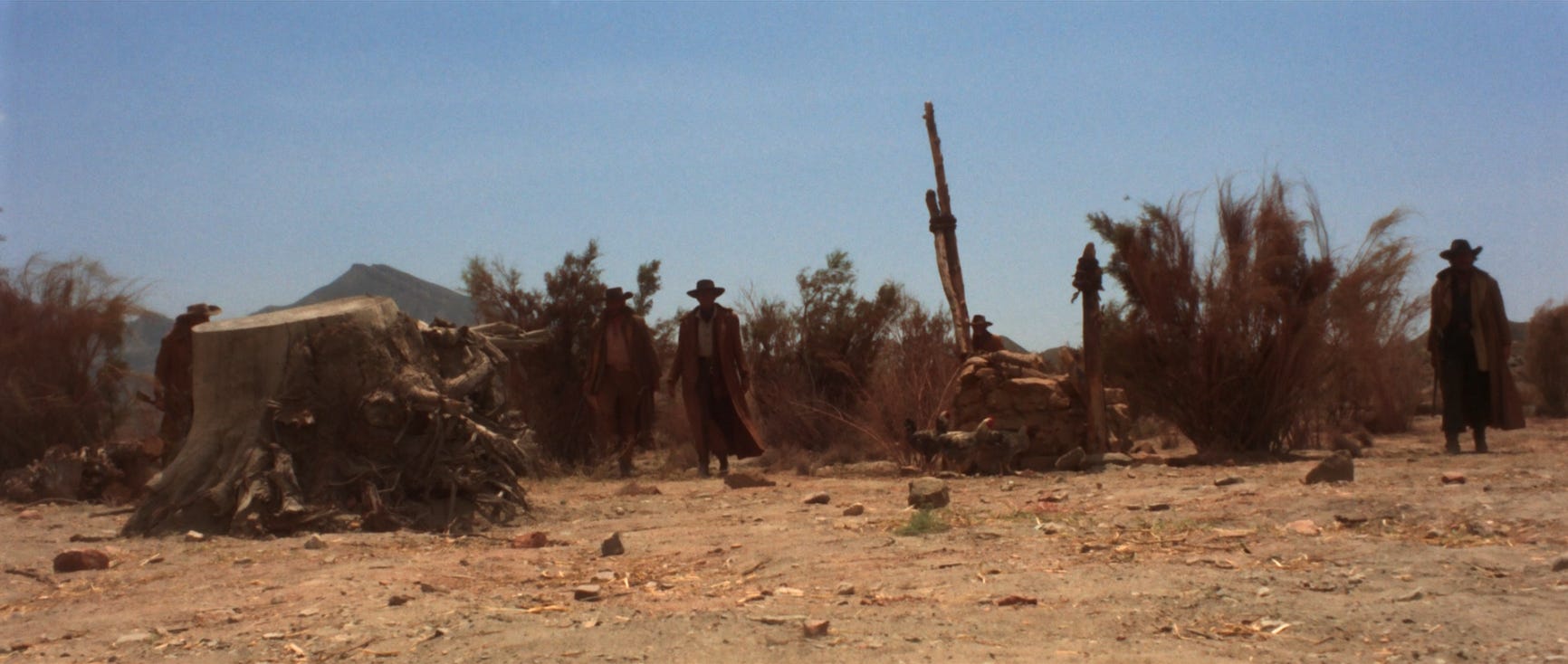
Frank gets, arguably, one of the most iconic (and most shocking) character introductions in cinematic history. After gunning down a father, son, and daughter, Frank and his men emerge from the brush and the frame itself is tilted slightly off axis. Not enough to be blatant but just enough to feel off-kilter. Frank's presence causes a disturbance that we can feel before we even know who he is (and who is playing him). This off-kilter framing, the brutal introduction, the sadistic joy as Frank guns down a child, and the musical bond he unknowingly shares with Harmonica conspire to tell us what is mythically due: a reckoning, ritualized.
And the reckoning is already in motion before the full reveal. Harmonica could have killed Frank at any time. But that would’ve been pure revenge. Instead, he waits. He speaks the names of the dead. He makes Frank see the face beneath the myth. Because in myth, it’s not enough for the reckoning to arrive — to complete the ritual the condemned must know why.
This is Leone’s genius: he's not an archaeologist, digging through layers to explain them. He's more akin to an alchemist — compressing them, pressurizing them into a mythic form so you feel their weight. Through this meticulous compression, Leone orchestrates the ritual, making it a visceral experience for the viewer. The film's very structure becomes a ritual, inviting us not just to observe, but to participate in its solemn unfolding. It may not be rationally understood on first viewing but it doesn't need to be. By the time of the final and inevitable showdown, you feel the ritualized reckoning.
Tropes as Scaffolding
Once Upon a Time in the West presents itself as prototypically Western. It achieves this by drawing on a fistful of tropes from both classic Westerns and Leone’s own body of work: the lone gunslinger, the man with no name, the outlaw, the railroad baron, the dusty frontier town. But these tropes, though familiar, are not the source of the film’s meaning. Leone uses them as the visible structure beneath which the real meaning is layered, unseen. What looks like pure genre is actually myth in disguise.
More than just Leone’s last take on the Western, it serves as a solemn hymn, and perhaps a eulogy to the form. He pares away not only the conventions of the American Western, but even some of his own cinematic signature.
No quick cuts, kinetic violence, or modern irony.
Only long gazes, vast landscapes, and ritualized reckoning.
By drawing on familiar tropes, stripping them of momentum, and letting them breathe in mythic time, Leone creates space for something older to surface. The myth isn’t explained: it’s felt.
Once Upon a Time…
If you’ve ever loved this film without quite knowing why or felt something mythic beneath the dust, it’s because Leone is summoning an ancient myth in the guise of a Western. A myth resting on two pillars: judgment and reckoning, ritualized by characters as eternal and immovable as the desert stone.
If this resonated or sparked something familiar then consider subscribing to Cinemyth. All essays are free, and each one explores the symbolic structure behind the stories we love.