
Michael Mann’s Manhunter (1986) is the most influential film of the 1980s. On its face, that is a ridiculous claim: Manhunter isn’t quotable, is rarely referenced, and for the general public is mostly forgotten or even unknown.
Upon its release in 1986, Manhunter received mixed reviews, and fizzled at the box office, earning only $8.6 million domestic gross. Fans of Thomas Harris’s New York Times bestselling novel, Red Dragon, would seem to be a built-in audience, but they didn’t show up; perhaps word of mouth about the modifications to the story kept those fans away. Or perhaps it was confusion about the title. The production team changed the title from the slightly inscrutable Red Dragon to the more direct and accessible Manhunter. Ironically, it didn’t help.
However, over the years, Manhunter gained a loyal following on home video and cable TV, and received further attention when the 1991 release of The Silence of the Lambs rocketed Hannibal Lecter into the zeitgeist. With the benefit of hindsight, critics are almost uniformly positive—the film has a 90% critics rating on Rotten Tomatoes. Viewers are also positive, with ratings of 7.2 on IMDB and 77% on Rotten Tomatoes. But the gap between the critics and audience tells a story: Manhunter seems to resonate more with those who think about cinema seriously, but it has never really garnered widespread affection.
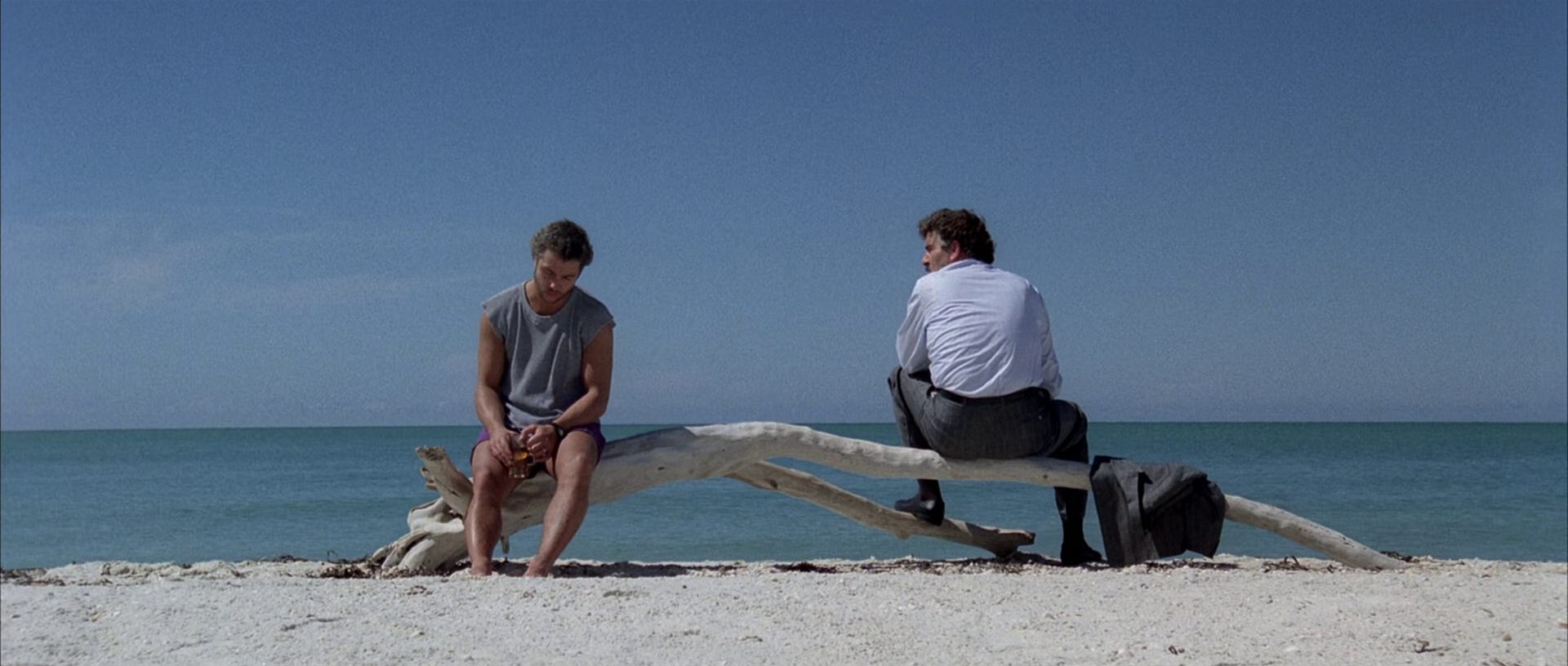
So, if Manhunter was a commercial flop and only a mild success in the intervening years, how can it possibly be the most influential film of the 1980s? The simple answer is CSI: Crime Scene Investigation. At its peak, it was the number one show in the world and spawned three spin-offs (CSI: Miami, CSI: NY, CSI: Cyber), a reboot (CSI: Vegas), as well as a cottage industry of similar police procedurals. If you trace the origin of CSI back, you end up at Manhunter. The connection is obvious, as both Manhunter and CSI feature William Petersen in the lead, playing a similar sounding character: Will Graham vs. Gil Grissom. In addition, the characters themselves are extremely similar. Grissom can be seen as a calmer, more detached, and scientific version of Will Graham. In other words, a character more suited to the format of a weekly procedural. If that were the only connection, this could be seen as a coincidence. But the lineage runs deeper than casting alone. The more direct influence is in how Manhunter brings the viewer behind the scenes into the investigation and, most importantly, into the lab. This puts forensics at the heart of the drama, with science and reason shown in opposition to the chaos unleashed by the killer.
Another core idea that Manhunter dramatizes is the idea of profiling—understanding how serial killers think so that they can be stopped. Manhunter was one of the first films to put profiling at the center of the story. This fascination with serial killer psychology has only deepened in the subsequent decades, spawning Criminal Minds, a franchise that survived two failed spin-offs and is currently in its 20th season on Paramount+.
A third influence that Manhunter presented was the humanized monster. Specifically, taking a serial killer and presenting them as both genuinely monstrous and deeply tragic. Mann interrupts the investigation at the beginning of the third act to focus on Dollarhyde and his life, and has the audience, for a few moments, actually pulling for the serial killer. While not an entirely new tradition, this was rare for a 1980s studio film and has come to be a common approach and, in the realm of prestige TV, the dominant storytelling mode.
Some may call it influence, others prescience but the roots that were planted are inescapable.
In a very real sense, Manhunter, when viewed retroactively, is a victim of its own success. Other shows took what it started and became television juggernauts, running for 15 or 20 years and became part of pop-culture. Ironically, when viewed by a modern audience, all of the new elements that Manhunter introduced appear less revolutionary and more familiar, and perhaps even mundane. And because Manhunter failed to cement a legacy early on, it is penalized for this familiarity instead of being celebrated for its innovation.
Of course, there is a giant shadow being cast over Manhunter, and it’s almost impossible to write about the film without bringing up Jonathan Demme’s The Silence of the Lambs. For the vast majority of viewers, this is how they first saw Hannibal Lecter (and it’s probably true to this day). Anthony Hopkins delivers a memorable, Oscar-winning, performance that for almost every viewer instantly cemented himself as the Hannibal Lecter. If viewers come to Brian Cox’s Lecktor performance (Manhunter changes the name of the character), this earlier portrayal appears as a poor copy of Hopkins’. And Cox’s Lecktor, as well as Mann’s film, have an entirely different tone, which is almost the polar opposite of Demme’s film. The Silence of the Lambs delivers everything an audience wants in a serial killer thriller: gothic feel, dark humor, quotable menace, and catharsis. It's a masterpiece of conventional satisfaction. Manhunter provides almost none of those moments: it refuses easy pleasures, offers nothing quotable, and keeps applying pressure with no clear catharsis. So any viewer expecting The Silence of the Lambs gets something that feels like an unfinished sketch in comparison.
Demme and Hopkins' Lecter makes you wake up in the night sweating. Mann's festers—asking you what exactly a monster is while you're quietly chopping carrots.
But The Silence of the Lambs was still five years away. To understand why Manhunter struggled out of the gate, we need to go back to 1986 and look at what audiences were actually watching.
The top 4 box office films for 1986 are very informative. (My apologies for excluding Aliens, which was #5.)

Top Gun leads the pack and embodies the 1980s aesthetic and zeitgeist: a Navy recruitment ad dressed as an MTV music video. But even more interesting, Crocodile Dundee, The Karate Kid Part II, and Back to School are all basically the same story. The fish out of water formula is one of the most reassuring narrative structures in cinema: outsider enters unfamiliar world, struggles, adapts, and eventually triumphs, restoring order. Top Gun even fits this same pattern with Maverick as an outsider. Not only did 1986 audiences want to find comfort in their entertainment, but they wanted a very specific comfort. If these were the films that 1986 audiences embraced, then what were some of the films audiences ignored?

Skipping Crimes of the Heart—a December release that found its audience the following year—the above list is genuinely shocking. Manhunter, Blue Velvet, and Something Wild, all rated over 90% on Rotten Tomatoes, directed by respected auteurs, regarded today as great films of the decade, all sat in the middle of the pack within $300,000 of each other.
If that was how the general public was voting with their wallets, what about the critics of the time? They're supposed to see past popular taste. Is there a reason for their divided response to Manhunter?
One reason might be Miami Vice fatigue. In 1985-1986, Mann’s (as executive producer) Miami Vice exploded as a top TV show. But even more impressive than the ratings climb was the hype and impact it had on the culture. Don Johnson and Philip Michael Thomas, the show’s two leads, were everywhere, along with their signature looks and fashion. The show was also trendy because of its combination of 1980s MTV aesthetic with neo-noir material (a combination so visually distinctive it earned its own descriptor: neon-noir). This is the exact same combination that Mann uses in Manhunter. In addition, in 1986, the television-to-film hierarchy was real and rigid; some critics would look at a film as suspect merely for emulating the hot stylistic television trend of the moment.
Besides this, the 1980s also suffered from an actual seriousness problem. This became more apparent as what today we think of as 1980s style evolved. Serious films of the 1970s immersed themselves in accepted forms: grit, decay, shades of gray (colors and morals) but a 1980s aesthetic of saturated colors, sleekness, and synths became coded as superficial emptiness. And this view is not without merit. So many 1980s films are style-first with a lack of depth. But Mann was making one of the most morally serious films of the decade in precisely the visual language critics had learned to distrust.
What specifically were the critics of the time saying? A Los Angeles Times review by Sheila Benson1 is informative:
From the first image, a young family pinpointed by the flashlight beam of a murderous intruder, “Manhunter” works like a chokehold. It’s only later, safely out of its grasp, that you begin to notice that for all its perverse fascination, and save for two superlative performances, “Manhunter” has delivered very little. Like the mirrors that dot it, “Manhunter” is all flat, brilliant, reflective surfaces.
And Benson’s final verdict:
With “Manhunter,” there seems to be some danger that style has overrun content, leaving behind a vast, chic, well-cast wasteland.
So while Benson has a variety of critiques (the score, Petersen’s charisma, alignment with the book), the main criticism is that style and form are given primacy over meaning and depth.
Paul Attanasio of The Washington Post watched the same film and came to almost the opposite conclusion2:
As written and directed by Michael (“Miami Vice”) Mann from the novel “Red Dragon” (by Thomas Harris), “Manhunter” is a gory and gorgeous cop thriller — you’ll forgive it almost anything, so full is your eye with the beauties of its design and photography, and your ear with its supercool electronic music. For all its faults, it’s one of the most sensually thrilling movies of the year.
Both reviewers see the same visuals. One finds a beautiful design. The other finds a stylish wasteland.
Even more interesting than Benson’s initial review is a subsequent analysis nine days later. Here the author digs deeper into Manhunter, sounds more charitable, demonstrates an understanding of Mann’s work, all without backing down from the initial, overall critique3.
What a ferocious movie “Manhunter” is. In the hands of director Michael Mann, it’s a dark locomotive of a film, roaring straight ahead, dragging its audience with it.
This follow-up analysis suggests that even a professional critic required some time to process the film (and felt compelled to express this in a follow-up article).
While critics seemed to be evenly divided, even the detractors admit that Manhunter is a great-looking film with the core question being: to what end? Is it just style over substance bordering on self-parody, as Benson contends, or is it used in service of something deeper and more meaningful? It’s my contention that in Manhunter, Mann has used 1980s style (that he helped define) in service of his story. Every formal element—color, light, blocking, costume, camera—is carefully chosen and deployed. These elements come to form a masterful cinematic grammar that infuses every frame.
Let’s take a look at an early scene from Act I.
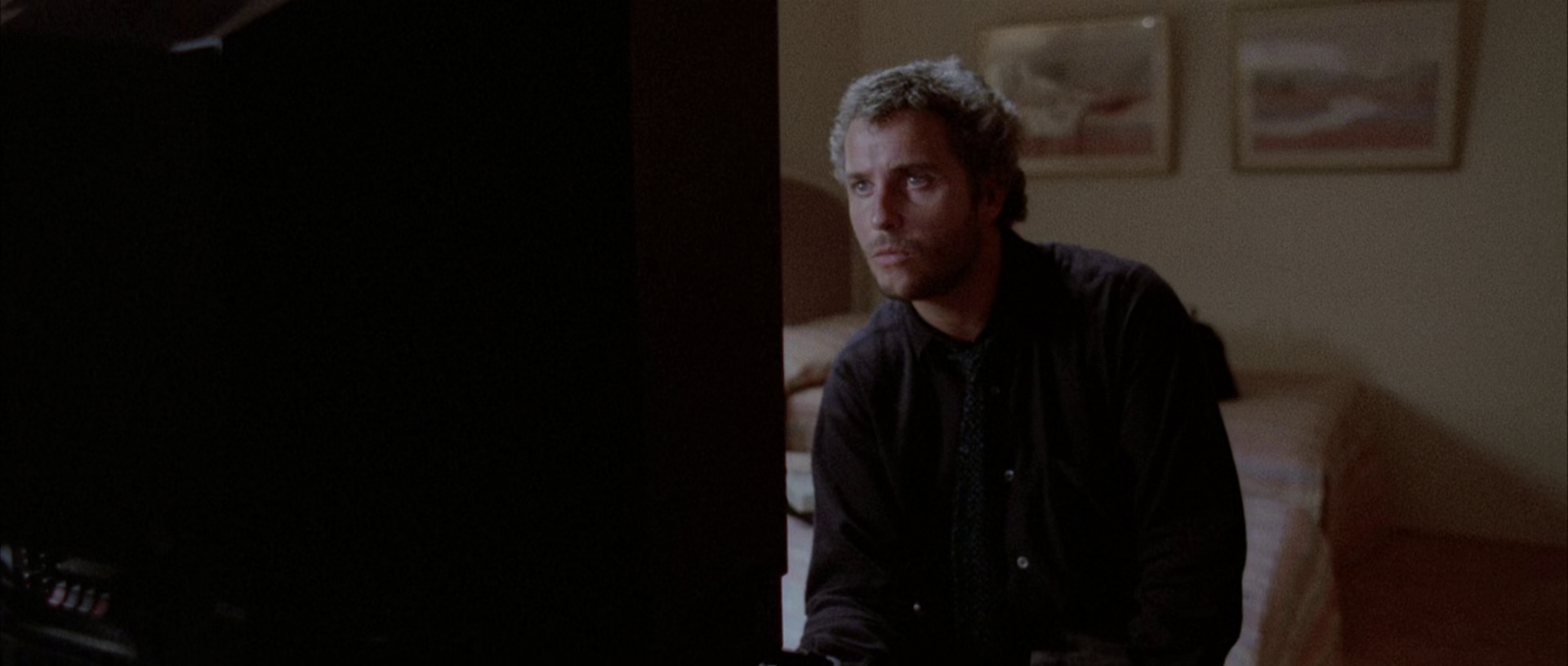
Will Graham is in his hotel room viewing video tape of the deceased families. The television forms a black void taking up fully half the frame. It’s isolating Graham from the audience which is a theme that continues throughout the film. The darkness in the frame is oppressive. Even alone in his hotel there is no escape for Graham as that black void presses into his space, an internal shadow that he refuses to outrun. Graham is usually framed as physically separate from other characters, but even here, alone in his room, he is still separate — staring into the darkness. The isolation isn’t social or situational; it’s metaphysical, representing both Graham’s gift and curse.
This is just the tip of the iceberg in terms of the cinematic grammar that Mann uses—other scenes use multiple design elements as symbols to indicate psychological state or unspoken relationships.
However, despite Manhunter being a masterpiece of layered visual grammar, it’s not a perfect film. And the main shortcoming is in the finale. The showdown withholds catharsis—deliberately, I believe—and because of that, Graham’s quick reconciliation with his family is too compressed to provide a satisfying emotional coda. The scene with Graham’s wife, Molly, feels too short and wraps up a bit too conveniently, given the stress the relationship was under for most of the film. And the ending matters because it disproportionately shapes the viewer’s memory of the film; how a film makes you feel in its final moments colors everything that came before.
But the ending is not the only source of audience resistance. The film is calm but unrelenting, Mann builds tension with almost no release. Manhunter prioritizes conceptual and formal coherence over catharsis or resolution. And the film presents its message subtly, it doesn’t explain itself, but instead plants seeds in the viewer’s mind. Seeds that germinate over time, making Manhunter worthy of repeated viewings and reflection.
Yes, Manhunter lost the cultural battle of the Lecters. But while we couldn’t take our eyes off Hopkins, it was Mann's measured vision that quietly seeped into the world we've been viewing ever since.
Explore more cinematic deep dives with free Cinemyth essays.
https://www.latimes.com/archives/la-xpm-1986-08-15-ca-3956-story.html
https://www.washingtonpost.com/archive/lifestyle/1986/08/15/the-gumshoe-glamor-of-manhunter/79f0d601-4699-48b2-914a-4a9e0860fab8/
https://www.latimes.com/archives/la-xpm-1986-08-24-ca-17494-story.html