
Dexter (2006-2013) was one of Showtime's most popular success stories in its foray into the world of "prestige" TV. With the recent prequel series, Dexter: Original Sin (2024-2025), and the latest sequel, Dexter: Resurrection, the Dexter franchise has now spanned nearly two decades. At this point it’s hard to believe that folks don't know who Dexter is and, if you don't, you should probably go and watch the original show as there will certainly be some spoilers ahead.
The finale to the original Dexter series was famously divisive. Some may even say reviled by the fan base as evidenced by its 4.8/10 rating on IMDB. Dexter: New Blood gave show runner Clyde Phillips (yes, we are naming names) the almost unprecedented chance to correct course and deliver a satisfying ending. The sequel show was both popular and well received. However, in a mind boggling turn of events, once again the finale was botched with the final episode somehow being even lower rated than the original Dexter finale this time garnering a 4.7/10 rating on IMDB.
Let's take a look at how and why a show managed to twice fail so spectacularly in attempting to satisfactorily wrap up its storyline. But instead of focusing on the narrative and dissecting the plot piece by piece let's step back and see what myth Dexter is telling and why it resonates.
Dexter As Mythic Constant Hero
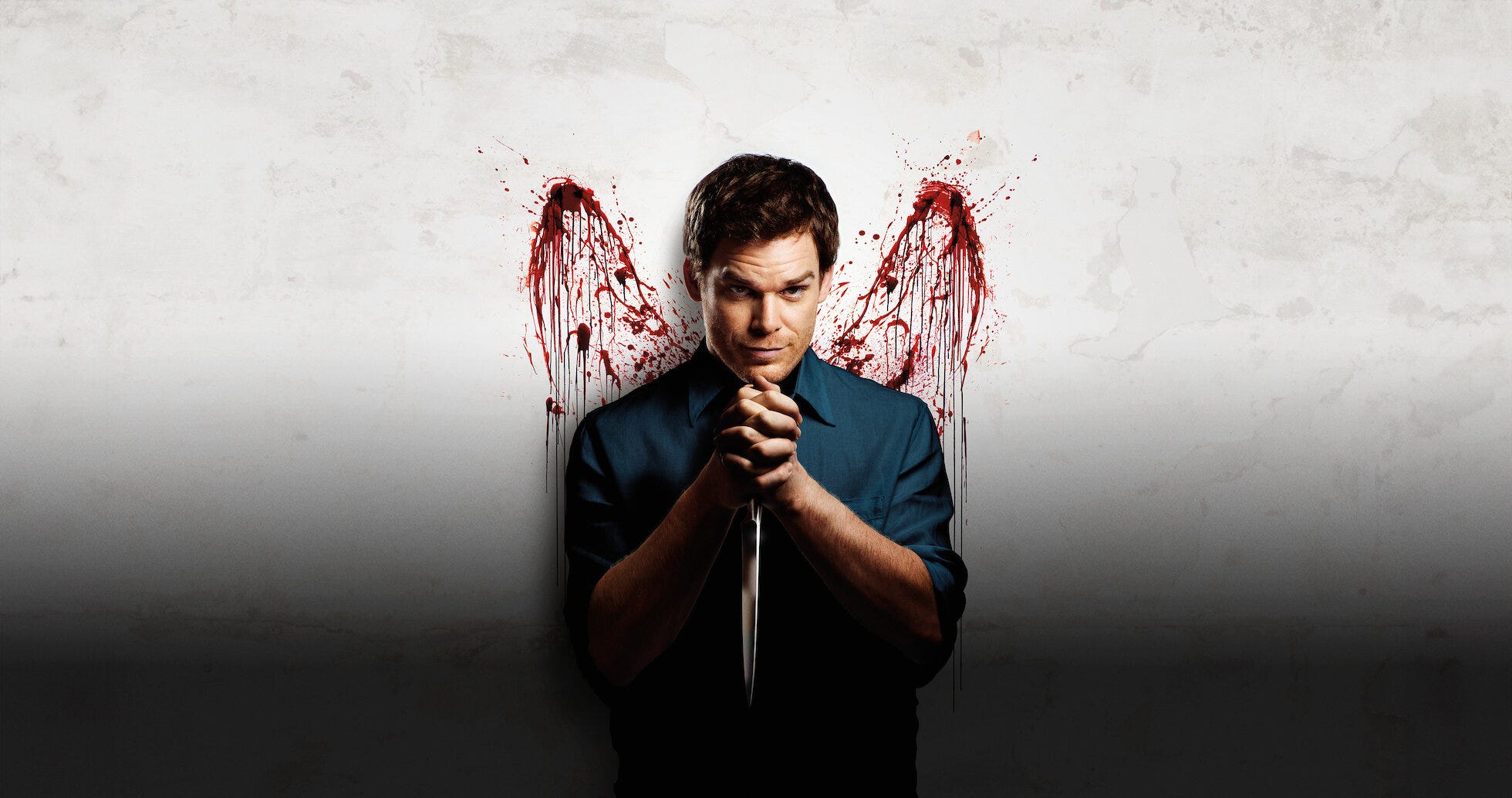
Dexter, as a character, is driven by his urge to kill. This so-called Dark Passenger was instrumental in Harry and Dr. Vogel's creation of the Code — a framework for channeling Dexter's desires into some potential good. This duality of murder as virtue sets Dexter up as one of the foremost anti-heroes in TV history. But why did audiences embrace this murderous character and even cheer for him week to week? Because Dexter isn’t just a flawed anti-hero, he's a Mythic Constant Hero who embodies ritual judgment.
The Mythic Constant
In order to help frame and understand the functioning of Dexter, I propose the concept of a Mythic Constant Character.
A Mythic Constant is an archetypal character who does not have a traditional arc. They are not fundamentally transformed in the course of events, embodying instead a timeless principle or unchanging force.
They enter the story fully formed with fixed values, and their behavior is shaped by adherence to these constant values. Other characters may change, react, or collapse in response to them, but the Mythic Constant either endures unchanged or is destroyed by their lack of change.
This idea is informed by archetypal literary criticism (e.g. Carl Jung, Joseph Campbell, and others) and, at first glance, may sound similar to the concept of a flat-arc protagonist. K. M. Weiland defines it like this: "the flat arc is about a character who does not change. He already has the Truth figured out in the beginning of the story, and he uses that Truth to help him overcome various external tests." So, yes, there is a similarity in that both characters have no arc and they both possess values or Truth but the main difference is one of function: the flat-arc character has a truth while the Mythic Constant Character embodies a more mythic principle or force.
A flat-arc character has values while a Mythic Constant Character is values.
Another interesting distinction between Mythic Constant Characters and more traditional characters is that with traditional characters we typically want to know more about them. We want to know their backstory, motivations, internal conflicts, and even delve into their psychology. But Mythic Constant Characters are almost pure symbol: the less we know about them the purer they function in the story as a symbol. In fact, excessive backstory or complexity can dilute the impact they have in embodying their timeless principle within the narrative. For a Mythic Constant Characters less is more.
Dexter's Code
Dexter's compulsion to kill is his driving force. It's an animalistic desire that needs to be managed. But this is not what makes the myth. The myth and its meaning only take shape when this need is bound to a code. Harry's Code gives form and meaning to Dexter's urges. Of all the rules of the Code two stand out above all:
Targets must be killers who have evaded the justice system
Killing must serve a purpose, otherwise, it's just plain murder
It's these two rules that frame Dexter's actions and the myth not as revenge or even retribution but as judgment. Dexter seeks out the unpunished who slip through the cracks in the system. The Code calls for death to balance the scales but it's the addition of Dexter's ritual that elevates this death to a reckoning.
Ritual and Last Rights
As mentioned, the Code dictates certain boundaries and procedures (such as who and why to kill, verification of the crime, etc.). This part of the code forms part of the ritual but it's Dexter himself who added other ritualistic aspects such as the plastic sheeting, the layout of the tools, the choice of clothing, the confrontation with the victim. In the narrative these details serve to satisfy Dexter's compulsions and keep him in control. However, mythically these ceremonies add a deeper symbolic meaning.

At the core of virtually every episode is the kill room. It's a makeshift room sheathed in plastic, a temporary cathedral for exacting karmic judgment. The kill room's precise dressing shows us that this is a sacred, separate space, set outside of normal reality. It's here that Dexter assumes the role of judge, jury, and executioner. The room is typically set up with a sacrificial altar at the center, the tools laid out ceremonially, and the space adorned with photos (or other items) illustrating the sins of the guilty. As Dexter presides over this ritual sacrifice, his simple clothes and apron are symbolically transformed into priest's vestments. But by far the most important aspect of this ritual is the final reckoning. This is where Dexter confronts the accused with their crimes, gives them the opportunity to confess and/or repent, and, most importantly for the myth, to make them aware of why they are being judged.
This cosmic dispensation of judgment is powerfully appealing to the viewer on an ancient and fundamental level, and our participation in the ritual provides an empowering catharsis.
The genius of the show is that it operates on a few different levels. On one level it appeals to our deeply ingrained sense of justice and retribution. On another, the Code allows us to consciously accept this baser instinct because it acts as a covenant and safeguard to stem the chaos, return order, and hopefully improve society. Dexter's repetitive ritual is befitting a Mythic Constant Hero and, in this role, Dexter acts as an ancient force of judgment outside of modern morality. And he's utterly compelling for it.
The Code's Cosmic Affirmation
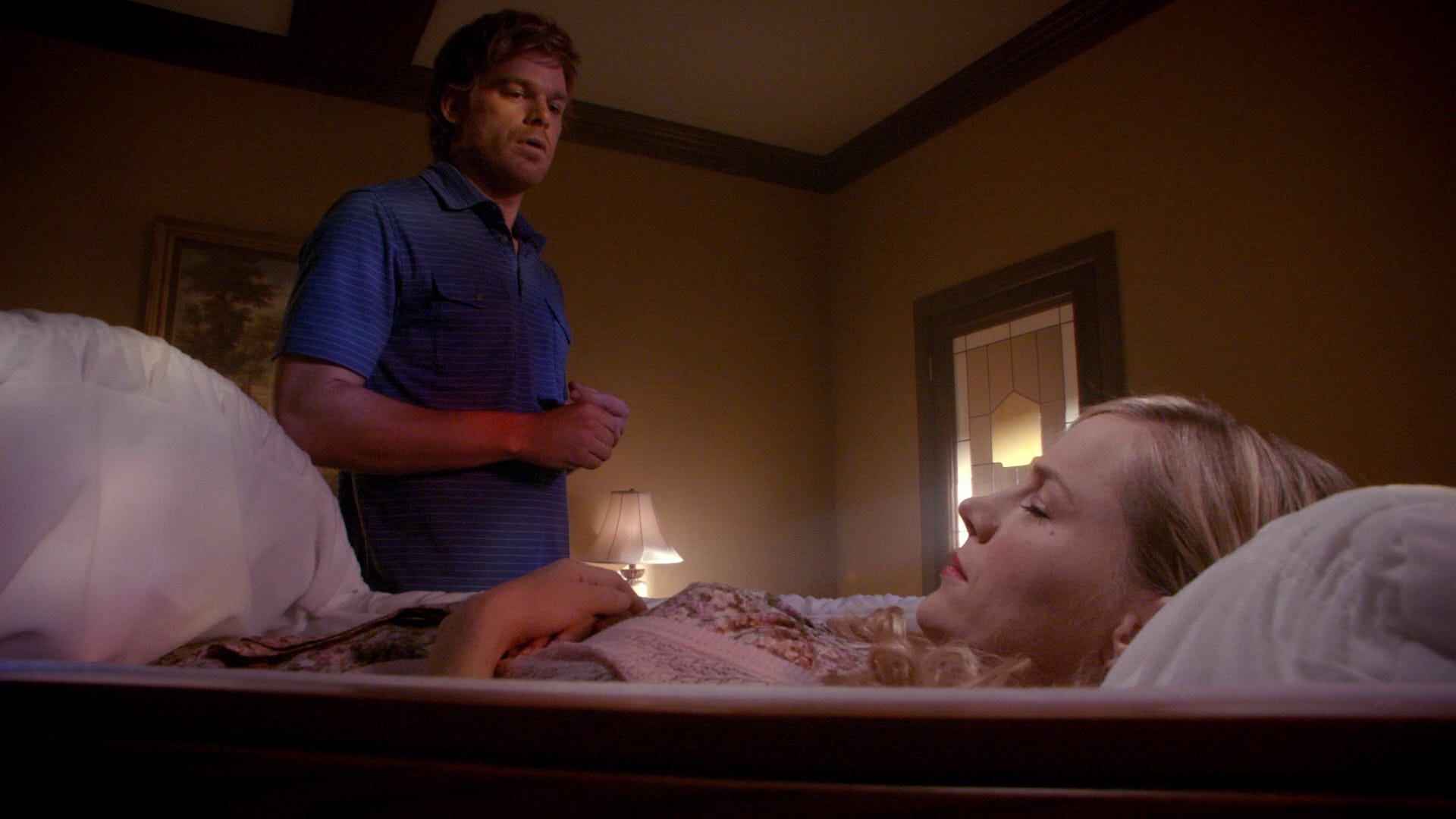
It's also worth examining what happens when Dexter violates the Code as these instances often underscore its cosmic significance. Two aspects of the Code that are most frequently violated, and with the clearest consequences, are:
Don't make things personal because it clouds judgment
Don’t get emotionally involved
Notice that these two elements of the Code are not life lessons; they are specific rules intended and useful for guiding a judge.
Over the course of the series, there are many examples of these violations, but the most striking and memorable is Dexter's pursuit of The Trinity Killer. Dexter allowed himself to become emotionally involved — seeing Trinity as a mentor he could learn from (to appear more human). This delay in carrying out the Code led directly to Rita's death. What becomes evident is that frequently when Dexter violates the Code (but not always) it leads to negative, sometimes catastrophic, consequences. Unfortunately, the show doesn't always connect these dots with clarity leaving the consequences often as implicit or incidental rather than ritualized. Even so, these moments serve as a kind of cosmic affirmation that the Code is not a random collection of rules, but a necessary framework that allows Dexter to bring order to the world.
However, when the Code is broken disorder and chaos soon follow.
Other Layers of Appeal
While Dexter's mythic role as judge forms the foundation of his appeal, it's also worth acknowledging other elements that contributed to the show's enduring popularity. First and foremost is the excellent cast, which almost goes without saying. Michael C. Hall's portrayal is so iconic that there's a good chance he never emerges from its shadow. From a production perspective the music, cinematography, and editing are also uniformly outstanding, befitting the prestige TV label.
Dexter as Serial Killer is (hopefully!) not relatable to the audience but the show adds enough character seasoning to make Dexter as a whole more relatable. Dexter is forced to present a normal mask to the world in order to fit into society and everyone can relate to hiding part of yourself away from the world in order to belong. Also hidden away is the shadow self, which is another point of relatability. Dexter embodies an almost pure example of the Jungian shadow but instead of wrestling with or trying to overcome it he embraces it. In a way, this makes it easier for the viewer to accept their own shadow self.
But let's not forget the humor. The show is consistently infused with a dry, darkly humorous wit, punctuated by an occasional macabre sense of humor that provides both levity and a unique tone. The show is sensationalistic but it is also trying to smartly entertain.
Yet other layers of appeal include the "B" plots. Frequently these stories revolve around Dexter's attempts at becoming more human (and failing) sometimes with awkward humor thrown in (the awkward failures were especially common in the more successful earlier seasons). These subplots do show some growth so Dexter, even as a Mythic Constant Hero, does change in some small ways. However, this change is not fundamental and doesn't affect his core mythic values.
The Finales of Failure
The irony with both Dexter and Dexter: New Blood is that they failed in the same way: both misunderstood the character and the myth. One more catastrophically than the other.
Since a Mythic Constant doesn’t have an arc, there are two possible ends for this type of character: they endure unchanged, or they are destroyed because they didn't change or because they failed to embody their core principle.
Dexter Finale
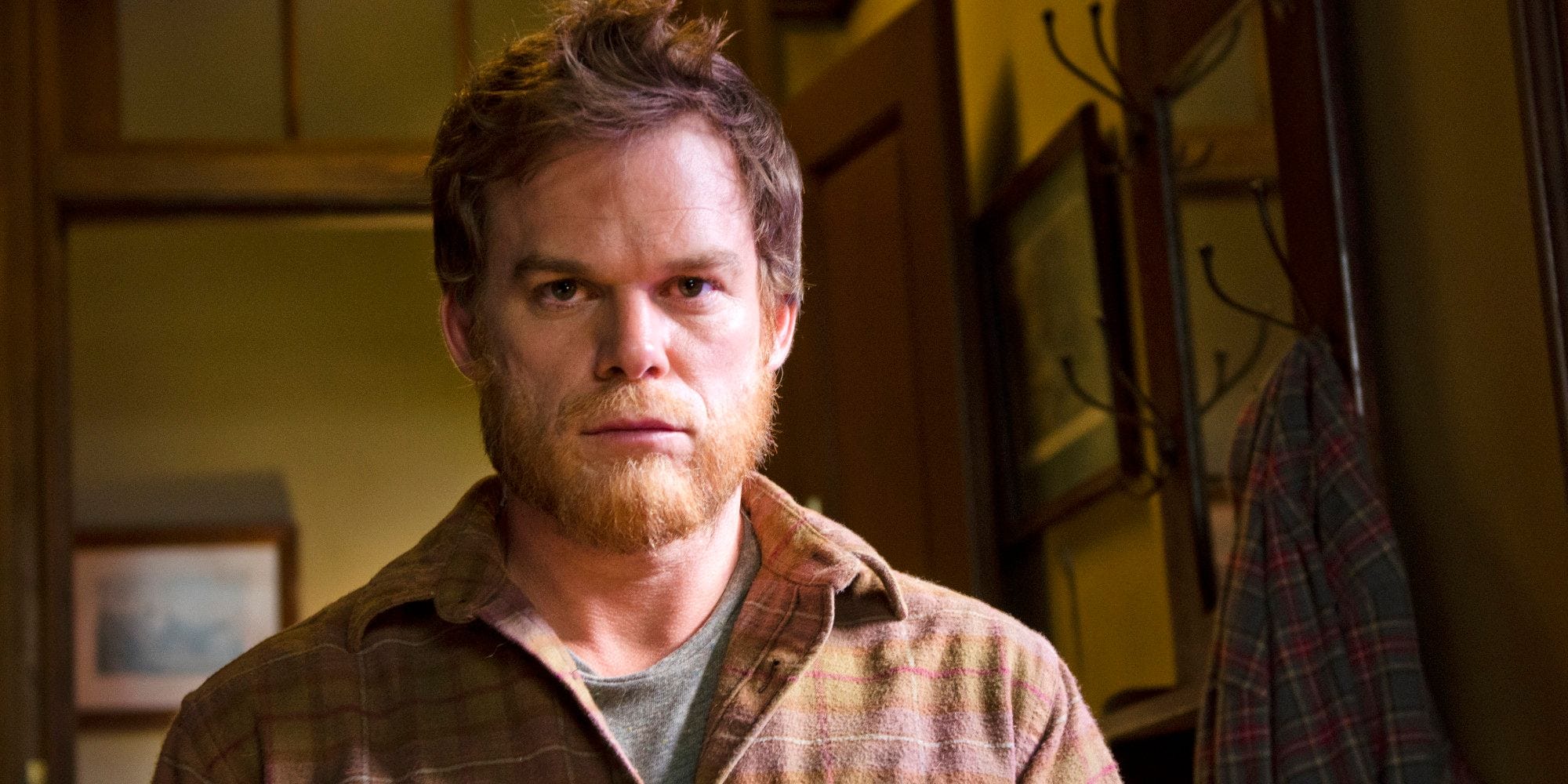
In Dexter, he fakes his death and is presumed lost at sea. But in the final scene, he’s revealed alive in Oregon, working as a lumberjack under a new identity.
Worse than a failure, this was a total mythic abdication.
No judgment. No ritual. No ceremony. No reckoning.
Narratively, the writers aimed to surprise the audience with Dexter’s supposed motivation of protecting his son. But this ending had nothing to do with the myth the series had built over eight seasons. The ultimate irony? In the end, Dexter’s emptiness mirrored the audience’s.
Dexter: New Blood Finale

In Dexter: New Blood, Dexter kills Sergeant Logan and his crimes and past are revealed to Harrison. Dexter has quick flashbacks to those whose deaths he was involved in (Rita, Deb, LaGuerta, Doakes, Lundy) and demands that Harrison shoot him. Harrison pulls the trigger and Dexter bleeds out.
The good news: New Blood is objectively stronger from a mythic standpoint. It inserts nods to legacy and reckoning. The bad news: it rushes the execution, skips the ritual, and devolves into a father-son therapy session.
Dexter's killing of Sergeant Logan is a clear violation of the code (Never kill an innocent) and can be seen as justification for Dexter’s death. The biggest problem with this is that there is only 13 minutes of screen time between Logan's death and Dexter's death. This doesn't give the audience enough time to assimilate and weigh the consequences of Dexter's actions. The rushed pace prevents us from feeling the mythic weight pressing down. If anything the pressure we feel is the police net closing in around Dexter. This prioritizes narrative pressure over mythic pressure which blunts any impact caused by the mythic crack.
Secondly, we never get a fully complete ritual. They try to invoke Dexter’s ritual with Harrison’s "Open your eyes and see what you've done” line and try to simulate the pictures Dexter places in the kill room by showing quick clips of dead characters where Dexter had some involvement in their deaths. But it’s a pale imitation of the ritual that only lasts a few short moments.
From there the scene pivots into a father-son therapy session. And, while, they're perfectly valid emotional beats, they are the wrong conversation to have at the threshold of judgment. What is demanded is a ritualized reckoning. Dexter, who as a Mythic Constant Character embodies judgment, must be judged through ritual.
Worse still, having Dexter insist that Harrison shoot him is a cop-out that undercuts the ritual. If Dexter is judging himself, then demanding someone else to execute that judgment is mythically incoherent and morally dubious. If Harrison is the judge then he must perform the ritual and perform the judgment. Instead, we get neither.
We are left with a dead hero, a traumatized son, and no catharsis.
Finally
With the new series Dexter: Resurrection I'm hopeful that the writers can learn from some of the missteps of Dexter and Dexter: New Blood and deliver a compelling story that honors the mythic bones of the original series. But after two finales that missed the mark, I'm not overly optimistic.
Please, Clyde Phillips, prove me wrong and honor the myth.
Ready for more insights? Every Cinemyth essay is free, unlocking the symbolic structures behind your favorite films. Subscribe now.