
Conan the Barbarian (1982). Arnold Schwarzenegger’s breakout role. The finest film of director John Milius’ career. The greatest sword and sorcery story put on film. And for latchkey children of the 1980s, probably the most inappropriately viewed movie ever.
![“If we didn’t have Arnold [Schwarzenegger], we’d have to build him” — John Milius](https://substackcdn.com/image/fetch/$s_!oed4!,f_auto,q_auto:good,fl_progressive:steep/https%3A%2F%2Fsubstack-post-media.s3.amazonaws.com%2Fpublic%2Fimages%2Ff08d0d11-d888-468c-8e3a-08c65a53415f_3840x1627.png "“If we didn’t have Arnold [Schwarzenegger], we’d have to build him” — John Milius")
Essential to the film’s success are Arnold’s charisma and pure physical presence, Basil Poledouris’ sublime score, plus Ron Cobb’s production design that transports you to the Hyborian age. Looking at the sequel, Conan the Destroyer, released two years later, one thing becomes obvious: all of the above are important factors in the original’s success, but something more is required. Conan the Destroyer, despite having Arnold, the same composer, the same world, and a similar aesthetic (and artists), falls so completely flat that, not only is it a lesser film, but it feels like it’s missing almost everything that made the original film so successful.
Conan the Barbarian is built on the back of pure pulp: the works of Robert E. Howard and the fantasy aesthetic of Frank Frazetta most of all. The film overwhelms the senses and appeals to baser instincts, featuring enough blood, nudity, and violence that Paul Verhoeven would, no doubt, approve. In an era permissive enough that a children’s adventure film could feature a shocking frozen corpse in a freezer and receive a PG rating1, Conan the Barbarian was rated X three times before finally receiving its R rating. Frankly, this is not the resume of a serious film.
If Conan the Barbarian is merely formulaic pulp, then why is the similar Conan the Destroyer such an inferior film? Could it be the sheer force of Poledouris’ score? It’s unlikely: a score can ruin as well as elevate but it can almost never create something from nothing. And how do we account for the ending of the film? It’s a final showdown that lacks the expected physical conflict (although it does provide the requisite gore), the score finishes with an elegy instead of a fanfare—a revenge story without any of the triumph.
Surely part of the answer lies in the execution. Poledouris’ score, Cobb’s production design, the costume design—each is masterfully executed. But it’s Milius’ coherent vision that pulls them into alignment. The result is a film that, despite being set over ten thousand years in the past, feels like a real world that we are immersed in. Or perhaps a dream of a world that could have been; it’s the ancient made visible to modern eyes. This weight is part of how the film overcomes its pulp origins and announces itself as something serious. The other main factor is that the film treats the story and characters with reverence—there are no jokes in the film to break this earnestness. Any humor arises from character moments: a drunk Conan punching a camel or Valeria pushing a passed-out Conan to the floor in the face of danger. The closest moment to a joke is perhaps Valeria’s “the lions ate him” excuse about why Subotai was not found with them, which is immediately shown to be a lie with Subotai’s near instant appearance. But even this “joke” is diffused by King Osric who immediately laughs at the timing, aiming the humor at the characters in the film and not the audience. The film demands the viewer to take it seriously.

Opening with a Nietzsche quote (”That which does not kill us makes us stronger”) is an easy reach for instant profundity. But Milius uses the quote to set the tone and to openly declare the film’s philosophical intentions: questions about strength, will, and endurance.
Milius wastes no time in driving the point home in the opening scene. Conan’s father explains the myth of Crom:
The secret of steel has always carried with it a mystery. You must learn its riddle, Conan. You must learn its discipline. For no one, no one in this world can you trust. Not men, not women, not beasts. This [Steel] you can trust.
Conan’s father describes steel as an “enigma”, “secret”, “mystery”, and finally “riddle”. In this opening scene, the mystery of steel appears to be a practical, physical consideration.
The next appearance of the riddle of steel is during Conan and Subotai’s discussion about their gods (on the soundtrack this scene is fittingly referred to as “Theology”). Conan describes what Crom demands of his worshippers:
If I die I have to go before him, and he will ask me, “What is the riddle of steel?” If I don’t know it, he will cast me out of Valhalla and laugh at me.
Conan’s father hinted at the riddle in the prologue and now, in Act I, Conan establishes the stakes for the riddle of steel.
The third, and final, appearance of the riddle is in Act II, where Thulsa Doom finally provides his answer to the riddle:
THULSA DOOM
Ah. It must have been when I was younger. There was a time, boy, when I searched for steel, when steel meant more to me than gold or jewels.
CONAN
The riddle...of steel.
THULSA DOOM
Yes! You know what it is, don’t you boy? Shall I tell you? It’s the least I can do. Steel isn’t strong, boy, flesh is stronger! Look around you. There, on the rocks; a beautiful girl. Come to me, my child...
After Doom coaxes the young girl to jump to her death, he continues:
That is strength, boy! That is power! What is steel compared to the hand that wields it? Look at the strength in your body, the desire in your heart, I gave you this!
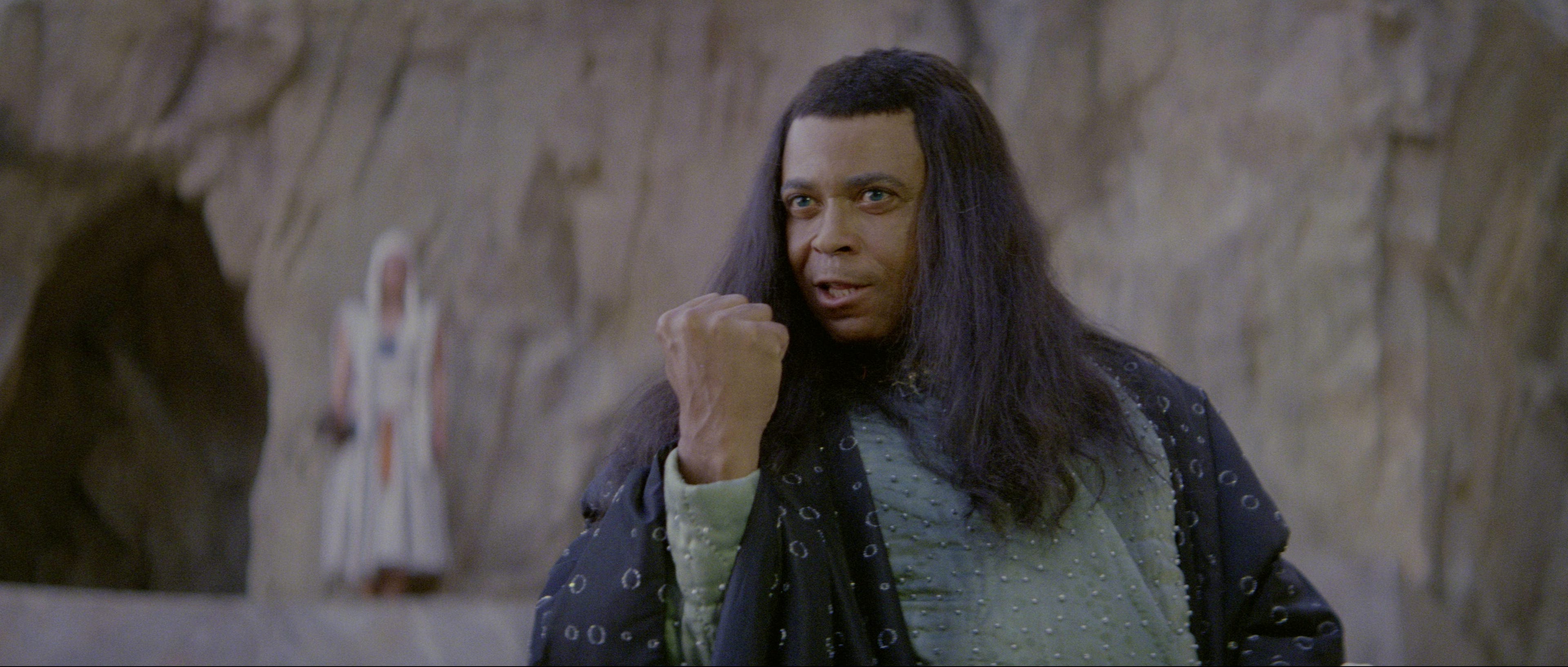
The three appearances of the philosophical question in each act is economic storytelling at its best: set up the riddle, explain the stakes, and offer an answer. All without actually resolving the deeper meaning—because surely the villain’s answer can’t be the final and correct reading.
Conan’s father expresses a simple view: steel is the only thing that can be relied on. Its innate strength is far superior to the inconstancy of animals and men. Doom argues flesh is stronger than steel—that will exerted over others is the ultimate power. Conan’s decapitation of Doom is the synthesis, showing that both the father’s and Doom’s philosophies are incomplete. Conan’s father wasn’t saved by his steel and, in the end, his sword broke. And even all of Doom’s acolytes and power couldn’t save him. Conan, through action, answers the riddle of steel: will is stronger than both steel and flesh—it is the ultimate power. At least, that’s the most common reading of Milius’ riddle.
But is the difference between Doom’s philosophy and Conan’s really all that different? Conan’s final act could be read as confirming Doom’s philosophy rather than refuting it. Conan does exactly what Doom describes: steel wielded by flesh and directed through pure will as the true source of power. Both ultimately resolve to will as the primary force—Doom’s will over others, Conan’s will over himself. Do we accept Conan’s version of the riddle simply because he is the hero? Or is there something genuinely different operating underneath—something the will reading doesn’t fully account for?
In the end, Conan achieves his revenge and returns the wayward daughter of King Osric to her home. It seems, as the Nietzsche quote promised, that his strength and will triumph over all obstacles. But is that even true? Let’s rewind the story and see how it plays out. Conan, desperate for revenge, abandons Subotai and Valeria, his friend and lover respectively. He then meets a “powerful wizard” who he also leaves behind, assigning him the menial tasks of oiling his sword and feeding his horse while he’s gone. Conan poses as a priest and attempts to infiltrate Doom’s Mountain of Power. He is exposed as an “infidel”, beaten mercilessly by Doom’s henchmen, and instructed to contemplate the riddle of steel while crucified to the Tree of Woe. Conan’s will—forged on the wheel of pain, tested in the pit, directed entirely toward revenge, fails completely. He doesn’t just stumble or get captured. He dies.
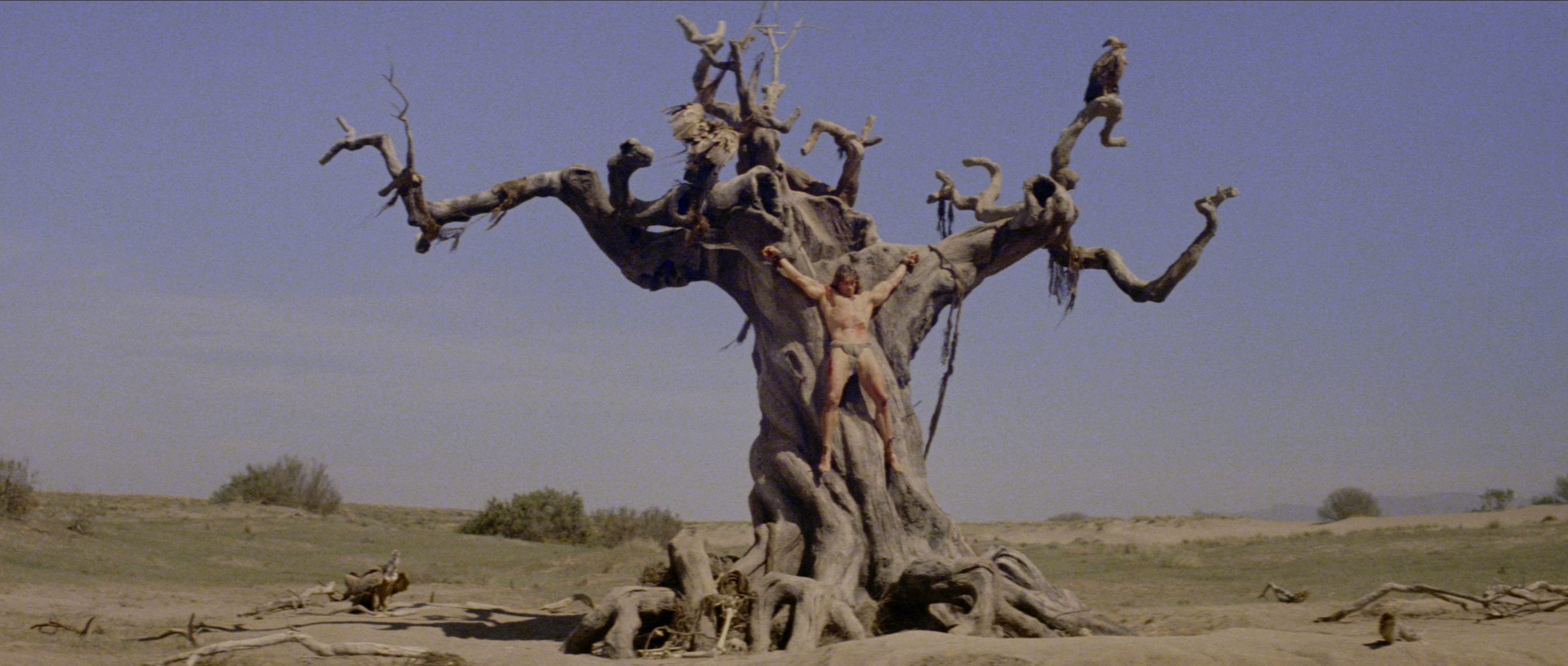
As Conan fights off scavenger birds on the Tree of Woe, a figure appears in the distance, perhaps an apparition, eventually revealed to be Subotai. However, Subotai arrives too late and can only rescue Conan from the indignity of the vultures. Valeria then chooses to make a fateful bargain:
VALERIA
Do the gods owe you any favors?
WIZARD
There are dangers...but I see you care little for those. The spirits of this place extract a heavy toll.
VALERIA
Then I will pay them.
The spirits come at night and try to take Conan but Valeria fights them off. It’s not until first light that Conan is finally resurrected.
Conan could not have completed his revenge without the help of Subotai and Valeria. They save Conan from the Tree of Woe and even bring him back from the dead. They aid him in rescuing the princess and defeating Doom’s forces. For all of Conan’s strength and resolve, his will was not enough. The only thing that carries him to his revenge is the devotion of his friends—Subotai pulling him from the tree, Valeria paying with her life to pull him back from death itself. Will is necessary but not sufficient. The missing piece is devotion.
But isn’t this just semantics? Will. Devotion. What’s the difference?
There is a difference, and the distinction is important. Will is directed inward. It’s self contained and belongs to the individual. It’s inner strength. Devotion, on the other hand, is directed outward; towards something beyond the self, something worth acting in service of.
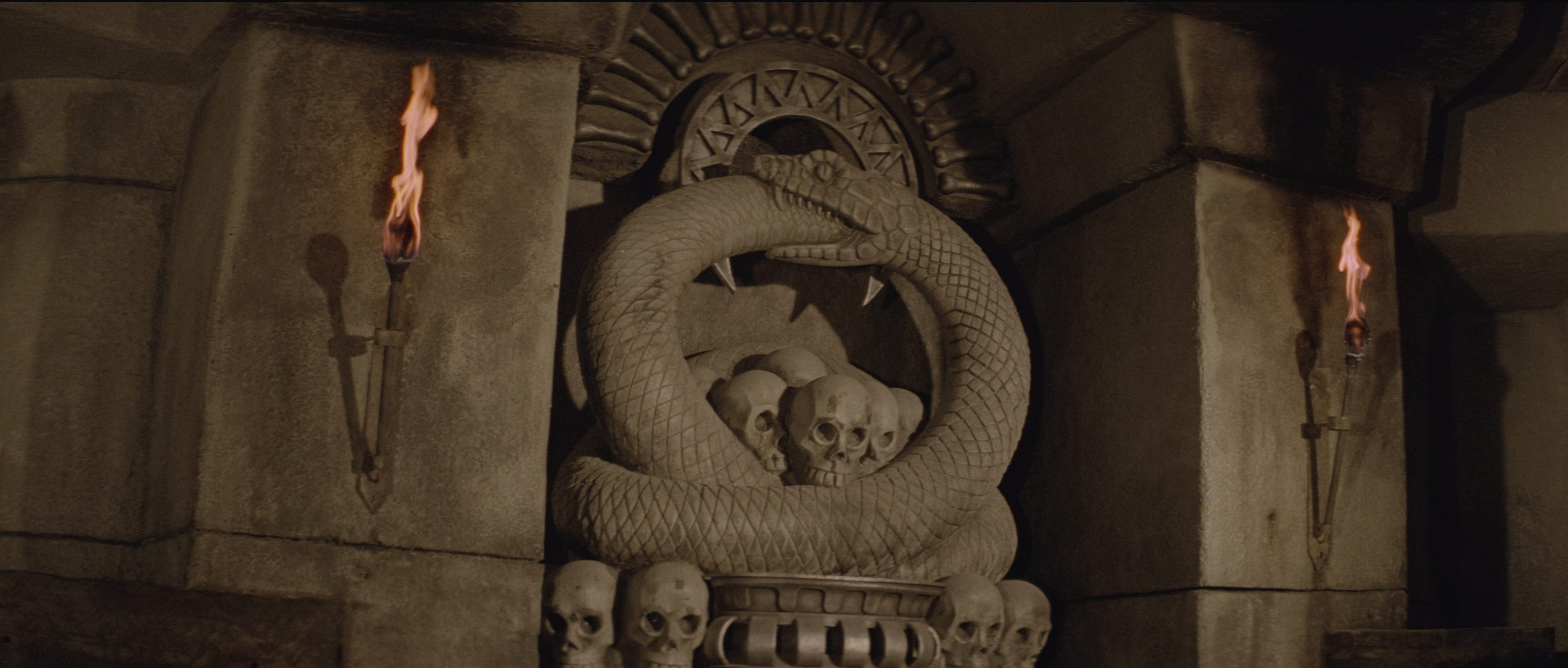
Thulsa Doom represents corrupted devotion. He demands it from others. Parasitic and extractive, it is a total inversion of the genuine article. This is the entire basis of his cult, but it’s most visible in the riddle of steel scene where he asks the girl to jump to her death. A Cult of Set symbol, a snake devouring itself, is made literal through its cannibalistic practices; Doom feeds off his acolytes’ devotion and, literally, on their flesh. In the end, we see how fragile this kind of devotion is—as soon as Doom is beheaded, the crowd simply disperses.
Conan’s desire for revenge is fueled by a devotion to the memory of his parents and his people. It’s a devotion to the ghosts of the past. It makes no demands of others and only expresses itself in his quest to find those responsible. From the outside, revenge appears as pure will, but the motive force is driven by a thirst for justice. Ironically, after Conan is released from slavery, his quest for revenge enslaves him again, pushing Subotai and Valeria away, almost costing him his life and forcing Valeria to trade her life for his.
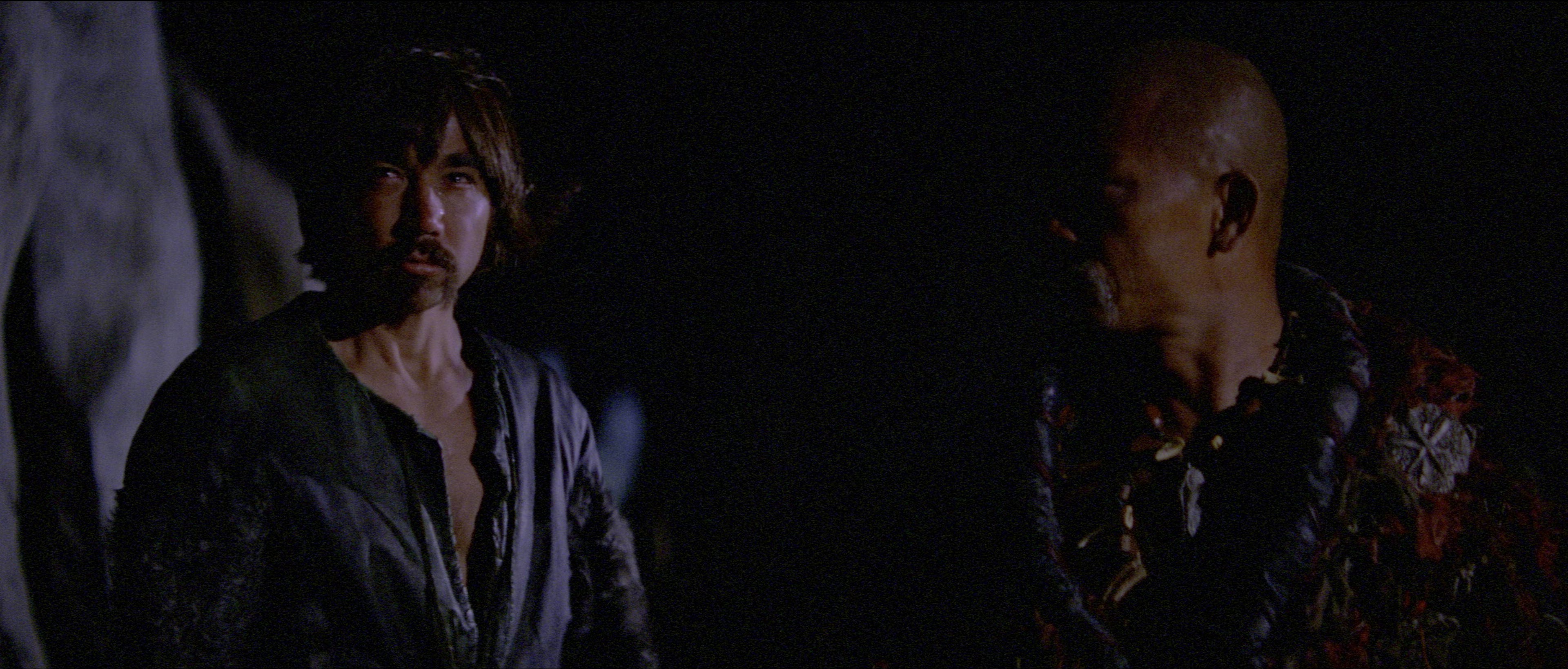
Subotai’s devotion is that of friend and companion. Unlike Doom’s form of devotion, it is freely given between equals. One of the most memorable scenes in the film has Subotai asked why he weeps at Valeria’s funeral pyre. His answer: “He is Conan, Cimmerian. He won’t cry, so I cry for him.” Subotai supports Conan while maintaining his own identity. Like much of the film, Subotai’s devotion is never directly explained; perhaps it arises from Conan saving his life or because they both share a common desire for freedom—when we meet Subotai, he is chained, awaiting death similar to how Conan was chained for decades. Subotai risks his life for Conan, suffering an injury in the final battle, and, in the end, saves the princess from Doom's snake-arrow.
Valeria is thematically the most important character in the film. She embodies the highest form of devotion—transcendent devotion that is freely given. It’s a devotion so powerful and so complete that death itself cannot contain it. Valeria pledges her life in order to resurrect Conan, and upon his resurrection, she announces:
All the gods, they cannot sever us. If I were dead and you were still fighting for life, I’d come back from the darkness. Back from the pit of hell to fight at your side.
At the moment of Conan’s resurrection, it sounds like a confession of love. It uses the same archaic, theatrical language the film has embraced from the very beginning, obscuring that it’s actually a solemn vow—a vow filled with such deep devotion that Valeria is literally able to return from the darkness to honor it.
In their relationship, Valeria asks nothing from Conan except for warmth. The first time she mentions warmth is when she pleads with Conan to stay with her and forget about Thulsa Doom. However, Conan leaves her to seek the Mountain of Power alone. The second time she mentions warmth is as she dies in Conan’s arms, “I’m so cold! So cold. Keep me warm.” Conan fails to keep her warm on both occasions, but her constancy was not swayed; she seeks Conan out and gives Conan the ultimate gift at the ultimate cost. Her devotion grants her transcendence. As Conan lies on the ground, with Rexor above him, about to deliver a decisive blow, Valeria, dressed as a glowing Valkyrie, keeps her vow, returning to block Rexor’s strike and temporarily blind him, saving Conan’s life for a second time.
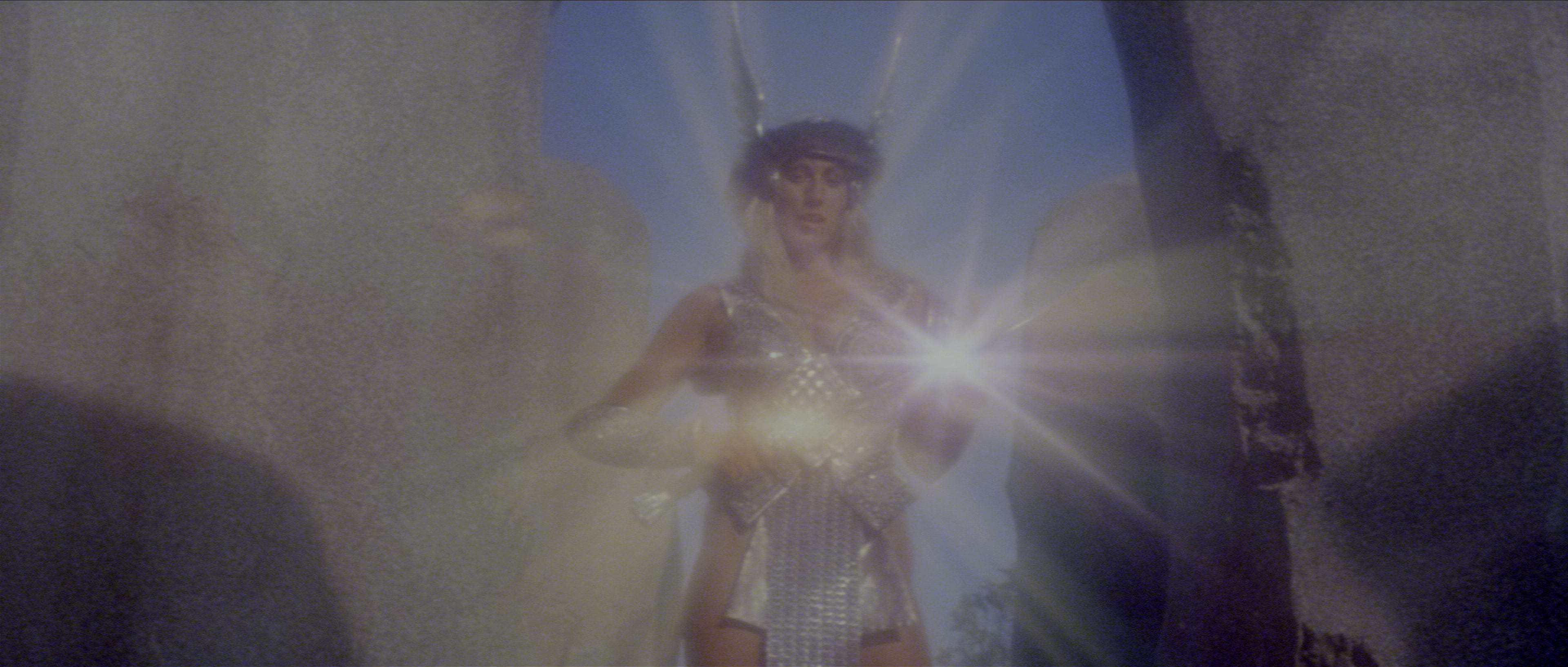
Thulsa Doom, Conan, Subotai, and Valeria represent an escalating hierarchy of devotion. Doom’s parasitic devotion is fundamentally evil, marking him as the villain. Conan’s devotion to the dead is a strong motivator, driving the story, but is shown to be ultimately insufficient. Subotai’s devotion is steadfast and unglamorous, the first true human connection we see. Finally, there’s Valeria’s spiritual and transcendent devotion—a connection that not even death can sever.
But there is an asymmetry in the devotion that Conan inspires; Subotai, Valeria, and even the wizard are all devoted to Conan, but Conan does not reciprocate that devotion. This prompts a question: why are the other characters so devoted to Conan? Milius’ answer is that the prerequisite for devotion is discipline and mastery of the self. Only after the will has been strengthened can it inspire devotion. Furthermore, Conan doesn’t need to reciprocate the devotion given to him. The simple act of being worthy of devotion is a gift that Conan gives but also receives. It’s a gift not because it demands anything of others but because it allows Subotai and Valeria to become more than they were—from thieves to heroes. By weeping Conan’s tears, Subotai becomes more human, more whole. By being someone worth dying for, Conan gives Valeria the opportunity to transcend death. This is the exact inverse of Doom. Doom’s followers jump off cliffs and dissolve into nothing. Valeria dies and becomes a Valkyrie. The same act—dying in service of another—produces opposite outcomes depending on the worthiness of the object of devotion.
Devotion to something worthy enlarges you. Devotion to something unworthy consumes you.
But what about the riddle of steel? Conan’s father put his trust in steel. But steel isn’t the answer. Doom was right to a point: steel is nothing without the hand that wields it. But flesh isn’t the answer. Strength of will is necessary. But pure will isn’t the answer. Devotion is the missing piece to the puzzle. But devotion is also not the answer. The answer to the riddle of steel is that true strength comes from endurance, will, and self-mastery bolstered by a circle of devotion that makes everyone stronger.
Conan the Barbarian was the perfect vehicle for John Milius. The Hyborian age, a world set thousands of years before recorded history, gave Milius a canvas free from modern politics, mores, and other distractions. Stripped of those constraints, his philosophic vision could be expressed in its purest and most uncompromising form.
Milius famously remarked that if they didn’t cast Arnold Schwarzenegger as Conan, “we’d have to build him.” Schwarzenegger’s physical presence is so overwhelming that the audience instinctively accepts Conan as the ultimate self-sufficient hero even as the film systematically dismantles that assumption under cover of swordplay and sorcery. Similar films are remembered only as empty fun or pure nostalgia but Conan the Barbarian endures because of solemn truth buried beneath the thundering score, giant snakes, and lakes of blood.
Subscribe. Crom won't laugh at you for it.
It’s The Goonies